Plant, herb
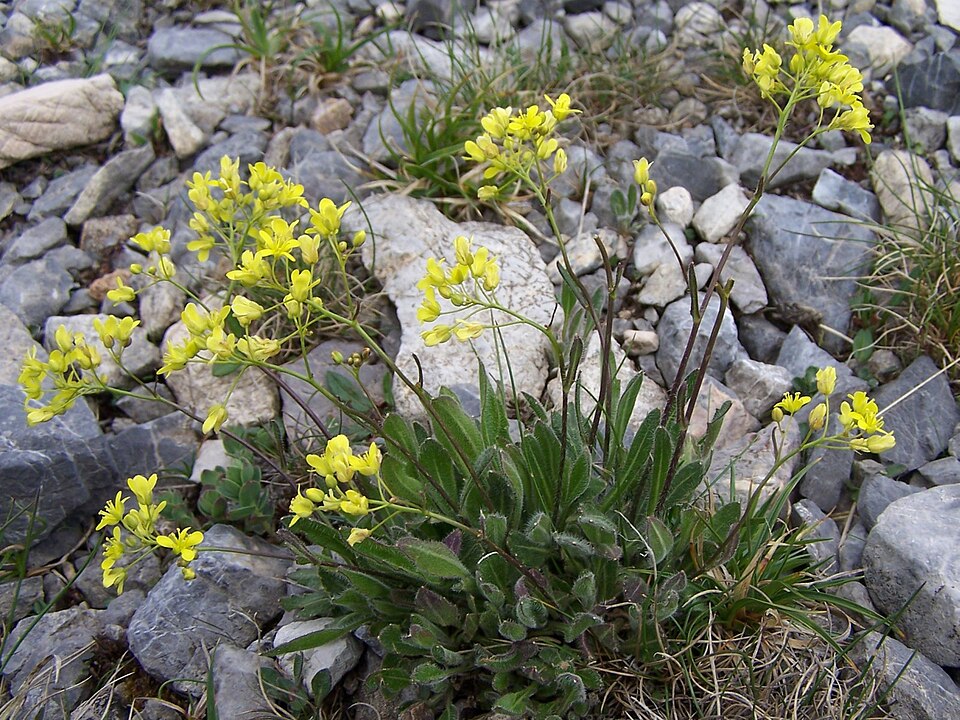
Biscutella laevigata
Buckler mustard
A mountain brassica that hyperaccumulates thallium in some mine-site populations. The population at Cave del Predil (the former Raibl mine, Julian Alps) gave one of the highest values ever measured in a plant.
How it works
- Mechanisms
- hyperaccumulation
Contaminants
| Contaminant | Evidence | What was shown |
|---|---|---|
| Thallium | field | Survey of metallophytes at the former Raibl lead-zinc mine (Cave del Predil, Udine): up to 32,661 mg/kg Tl in shoots of B. laevigata subsp. laevigata (Fellet et al. 2012). In hydroponics, at 5 µM Tl, more than 3,000 µg/g in shoots, with thallium in the vacuoles of the leaf epidermis (van der Ent et al. 2026).
|
Limits
Hyperaccumulation is facultative: it concerns only some populations (Les Malines in France, Cave del Predil in Italy). A small plant; the sources consulted report no field phytoextraction trials. Thallium-rich biomass is highly toxic.
Where it has been tried
Raibl mine, Cave del Predil
PhytoremediationField scale
Biscutella laevigata, Silene vulgaris
Not a clean-up trial but a survey of spontaneous metallophytes: plants collected on the tailings and along the banks of the Rio del Lago and Slizza, with bioconcentration and translocation factors calculated. A comparison of populations across north-eastern Italy showed that only the Cave del Predil one hyperaccumulates thallium, and that it is genetically distinct from the others.
Outcome In the shoots of B. laevigata: 0.49–1,587 mg/kg thallium, 20.6–3,391 zinc, 0.21–234 lead; in S. vulgaris: 0.01–578 thallium, 14.9–1,590 zinc. The authors prefer S. vulgaris for phytostabilising substrates low in thallium.
- Fellet G. et al. Potentially toxic elements in facultative metallophytes Biscutella laevigata and Silene vulgaris along the stream descending from the abandoned Raibl mine (Italy). International Journal of Phytoremediation 27, 2025
- Pošćić F. et al. Variation in heavy metal accumulation and genetic diversity at a regional scale among metallicolous and non-metallicolous populations of the facultative metallophyte Biscutella laevigata subsp. laevigata. International Journal of Phytoremediation 17, 2015
Sources
- Fellet et al., Plant Soil (record in the University of Udine repository), air.uniud.it, 2012
- van der Ent et al., Ann. Bot., 2026
Draft compiled from public sources, not yet reviewed.