Plant, herb
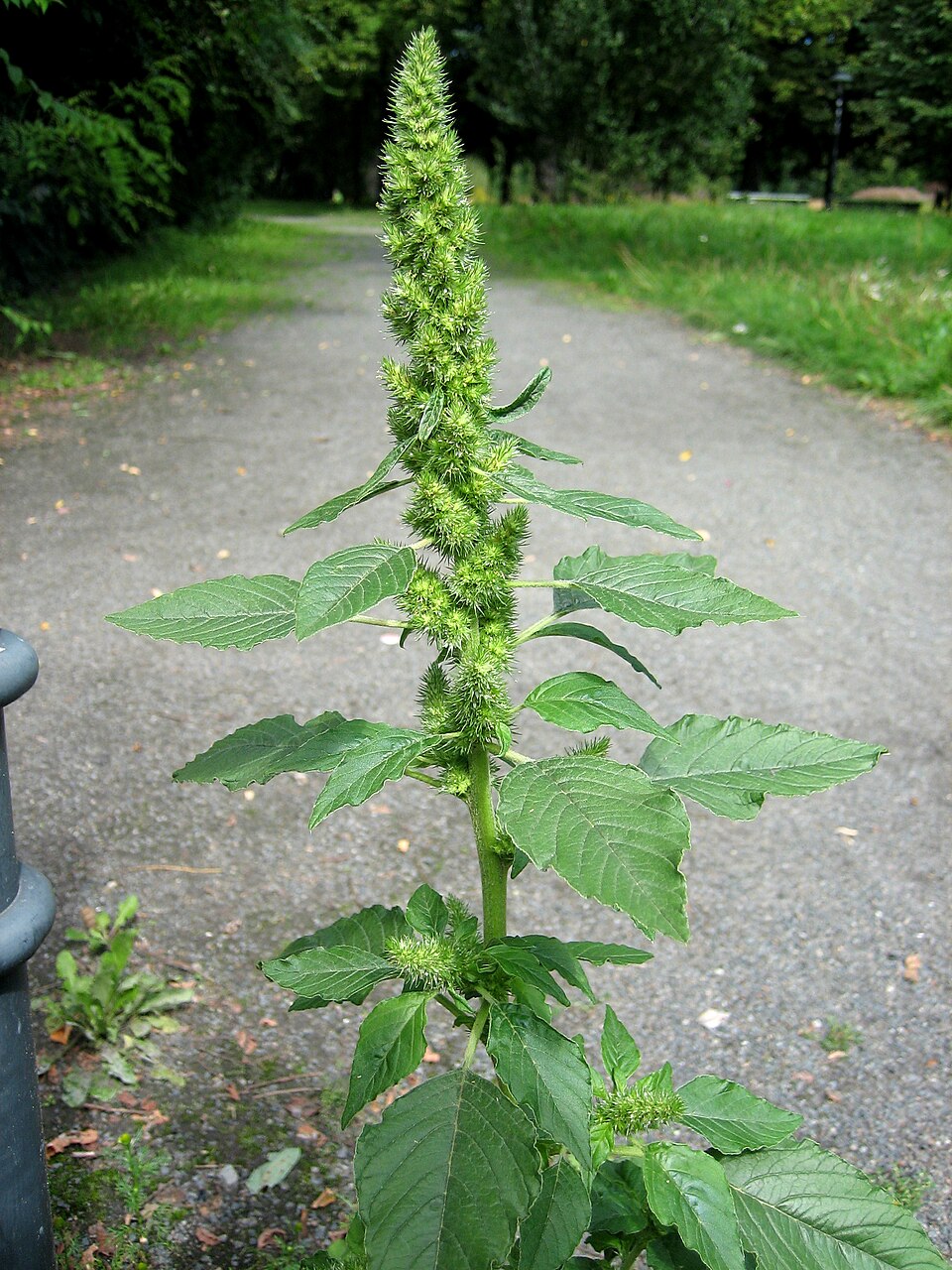
Amaranthus retroflexus
Redroot pigweed
A fast-growing annual weed, the species that extracted most caesium-137 from soil in field tests. It is also the measure of the technique's limits: in the best case it takes many years to halve the contamination.
How it works
- Mechanisms
- phytoextraction
Contaminants
| Contaminant | Evidence | What was shown |
|---|---|---|
| Caesium-137 | field | Field test on soil contaminated in the 1950s and 1960s: plant/soil concentration ratio of 2.58 for Cs-137, against 0.46 for Indian mustard and 0.17 for tepary bean; given its biomass it accumulated the most. The authors' estimate: 18 years to remove 50% of Cs-137 with two crops a year (Fuhrmann et al. 2002). In trials near Chernobyl amaranth cultivars showed the highest Cs-137 accumulation of the plants screened (Dushenkov et al. 1999).
|
| Strontium-90 | field | In the same test, a concentration ratio of 6.5 for Sr-90 (lower than mustard, 8.2, and tepary bean, 15.2), but greater total accumulation thanks to biomass; an estimated 7 years to remove 50%. Sr-90 uptake did not depend on its concentration in soil (Fuhrmann et al. 2002). |
Limits
Caesium binds to clays and its available fraction declines with time; ammonium salts are the most practical amendment to raise it (Dushenkov et al. 1999), with the risk of moving it towards groundwater. Estimated times are 7–18 years to halve, in the favourable case. Every harvest is radioactive waste to manage. It is a heavily seeding weed: it must be harvested before seed set.
Where it has been tried
Chernobyl Exclusion Zone
PhytoremediationField scale
Brassica juncea, Amaranthus spp.
Dushenkov with Mikheev, Prokhnevsky, Ruchko and Sorochinsky tested 20 soil amendments to bring caesium into solution, compared plant species and grew three successive crops of Indian mustard in one season on an experimental plot.
Outcome A modest result: the three crops gave only a small decrease in caesium-137 activity in the top 15 cm of soil. Amaranths accumulated more than the other species and ammonium salts were the most practical amendment. The authors conclude that further improvement is needed before the technique is usable. The famous trials with sunflowers on rafts in a pond and with hemp are cited everywhere, but no primary source with the measurements was found.
Sources
- Fuhrmann et al., J. Environ. Qual. 31:904, 2002
- Dushenkov et al., Environ. Sci. Technol. 33:469, osti.gov, 1999
Draft compiled from public sources, not yet reviewed.
Other species for the same contaminants
Species that the literature reports acting on at least one of this one's contaminants, the closest first.