Fungus, mycorrhizal
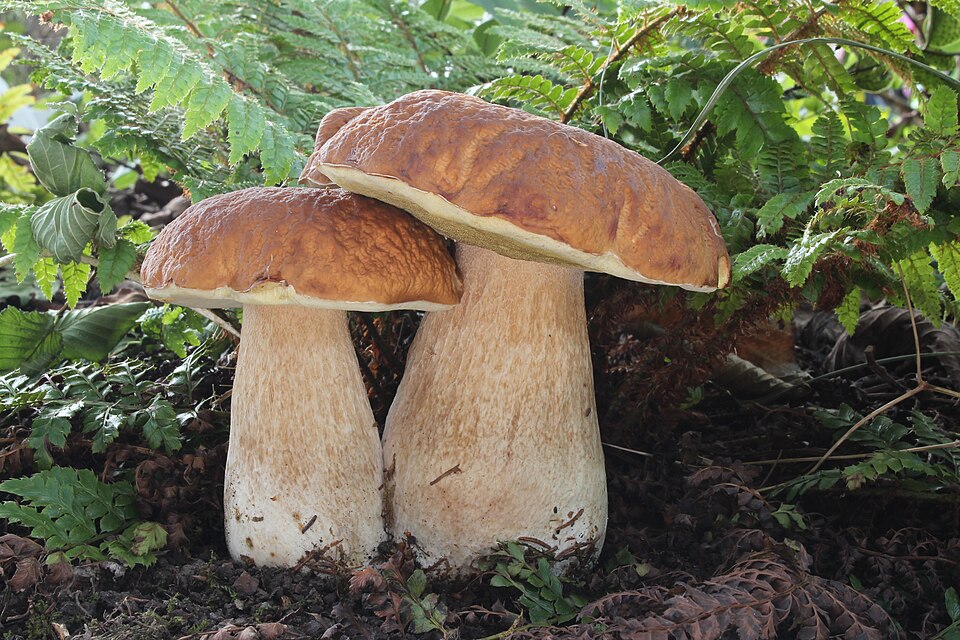
Boletus edulis
King bolete, porcini
An edible ectomycorrhizal mushroom, among the most collected in Europe. It concentrates mercury in its fruiting bodies to over a hundred times the soil level, even in forests with no local pollution source, and retains caesium-137 from Chernobyl fallout. It matters for food safety and as a bioindicator more than as a clean-up tool.
How it works
- Mechanisms
- bioaccumulation
Contaminants
| Contaminant | Evidence | What was shown |
|---|---|---|
| Mercury | survey of wild specimens | Measurements on wild mushrooms, not a remediation trial. At 13 sites in Poland total mercury in caps averaged 1.1 to 7.6 µg/g dry matter (extremes 0.02-14) and in stalks 0.82 to 3.8, on soils with only 0.02-0.05 µg/g; bioconcentration factor in caps 41-130 (extremes 13-170). In a background area with no local sources, 2600 ± 1200 ng/g. |
| Caesium-137 | survey of wild specimens | King boletes collected in 2019 in northern Poland: 360 Bq/kg dry weight at the button stage, falling with maturity. In Lucca province (Italy) fresh boletes had 41.8 ± 5.2 Bq/kg dry weight in the Tuscan-Emilian Apennines and 12.8 ± 1.3 in the Apuan Alps, among the lowest values in Europe and below the 600 Bq/kg limit.
|
Limits
It cannot be cultivated: it depends on its host tree, and fruiting-body mass is tiny against the soil, so accumulation removes no useful amount of metal. The risk runs the other way, to food: the authors propose for unpolluted sites a ceiling of 20 µg/g dry matter mercury for a single cap and 10 µg/g on average. Braising concentrates caesium-137 on a fresh-weight basis (+110 ± 69%).
Sources
- Falandysz, Frankowska & Mazur (2007) J Environ Sci Health A 42:2089-2095, 2007
- Falandysz et al. (2002) Environ Int 28:421-427, 2002
- Falandysz, Saba & Strumińska-Parulska (2021) Chemosphere 268:129336, 2021
- Betti et al. (2017) Food Addit Contam A 34:49-55, 2017
Draft compiled from public sources, not yet reviewed.
Other species for the same contaminants
Species that the literature reports acting on at least one of this one's contaminants, the closest first.