Fungus, mould
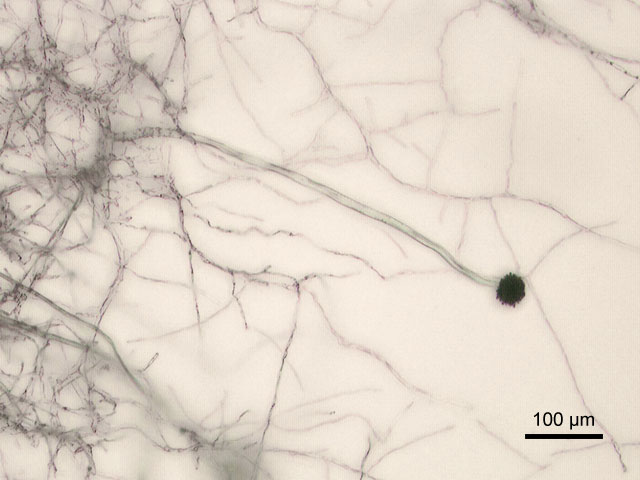
Aspergillus niger
Black mould
An industrial mould used to produce organic acids. With metals it acts in two opposite ways: the biomass binds them (biosorption) and the acids it secretes, chiefly oxalic acid, bring them into solution, which is exploited to wash contaminated soils or biomass.
How it works
- Mechanisms
- biosorption
Contaminants
| Contaminant | Evidence | What was shown |
|---|---|---|
| Zinc | laboratory | Resistant strain, 100 mg/L metal with 1 g biomass, 28 °C, pH 4.0-5.5: 100% of zinc removed; the fungus grows at up to 2000 ppm zinc, lead and mercury. |
| Mercury | laboratory | Same conditions: 83.2% of mercury removed from 100 mg/L. |
| Copper | laboratory | Same conditions: only 37% of copper removed (cobalt 71.4%). |
| Arsenic | laboratory | Washing of co-contaminated soil with A. niger fermentation broth (undiluted, pH 1, liquid/solid 15:1, 25 °C, 3 hours): after three washes 85.83% of arsenic and 82.06% of antimony were removed; the active agent is mainly oxalic acid. |
| Cadmium | laboratory | Bioleaching of sunflower stalks used for phytoextraction: 67.67% of cadmium removed in 11 days (initial pH 3, sucrose 76 g/L), leaving the N, P and K of the biomass unchanged. |
Limits
Metals are not degraded: biosorption moves them from water to biomass and washing moves them from soil into a very acidic liquid (pH 1), both of which then need disposal. Sorption tests use simple 100 mg/L solutions, far from a real effluent. All laboratory work.
Where it has been tried
Fidenza (former CIP and Carbochimica plants)
MycoremediationLaboratory, with soil from the site, 2016–2020
Fusarium oxysporum, Fusarium solani, Trichoderma lixii, Aspergillus spp., Pseudomonas putida, Achromobacter xylosoxidans, Ochrobactrum anthropi
Soil from the site, sampled at three depths (0–1, 1–2, 2–3 m), was enriched in the laboratory on benzene, paraffin, pyrene, naphthalene, phenanthrene and crude oil, tracking the bacterial and fungal communities by sequencing. Among the fungi isolated Fusarium dominated, followed by Trichoderma and Aspergillus; among the bacteria, Pseudomonas. Strain Trichoderma lixii MUT3171, isolated from the same soil and kept in the Mycotheca Universitatis Taurinensis, was later genome-sequenced.
Outcome 95 bacterial and 94 fungal strains able to grow on the pollutants were isolated. T. lixii MUT3171 grows on phenanthrene as its sole carbon source. The studies do not measure removal in soil.
- Polycyclic aromatic hydrocarbons
- BTEX (benzene, toluene, ethylbenzene, xylenes)
- Petroleum hydrocarbons
- Spini G. et al., Molecular and microbiological insights on the enrichment procedures for the isolation of petroleum degrading bacteria and fungi, Frontiers in Microbiology 9:2543, 2018
- Venice F. et al., Genome sequence of Trichoderma lixii MUT3171, a promising strain for mycoremediation of PAH-contaminated sites, Microorganisms 8(9):1258, 2020
Sources
- Kapoor, Viraraghavan & Cullimore (1999) Removal of heavy metals using the fungus Aspergillus niger. Bioresour Technol 70:95-104 (bibliographic record only), 1999
- Acosta-Rodríguez et al. (2018) Bioinorg Chem Appl 2018:3457196, 2018
- Chai et al. (2023) Environ Sci Pollut Res 30:82866-82877, 2023
- Zhang et al. (2024) Environ Res 251:118714, 2024
Draft compiled from public sources, not yet reviewed.
Other species for the same contaminants
Species that the literature reports acting on at least one of this one's contaminants, the closest first.