Fungus, mould
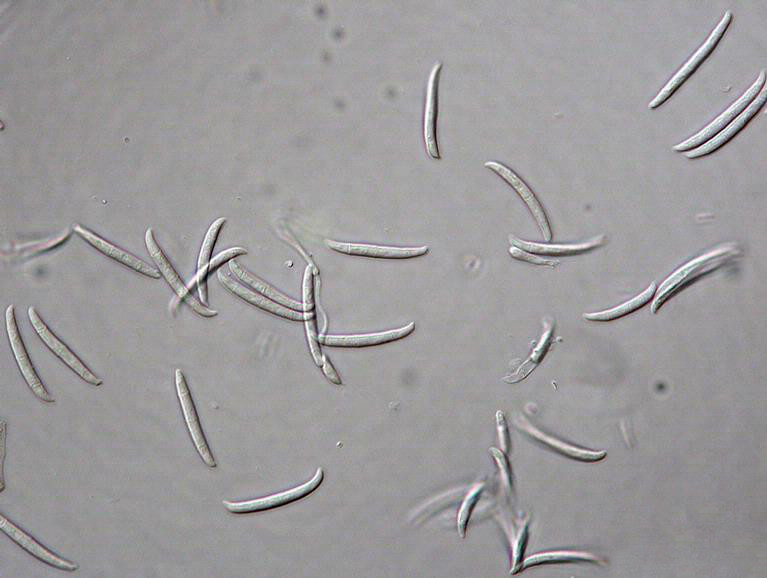
Fusarium solani
A saprotrophic soil ascomycete isolated from soils contaminated with cyanide and with fossil carbon. It hydrolyses cyanide under alkaline conditions, which avoids acidifying the effluent, and degrades benzo[a]pyrene through a non-ligninolytic route linked to lipid metabolism.
How it works
- Mechanisms
- mycodegradation
- Enzymes
- cyanide hydratase
Contaminants
| Contaminant | Evidence | What was shown |
|---|---|---|
| Cyanide | laboratory | Strain IHEM 8026, isolated from contaminated soils, degrades cyanide at pH 9.2-10.7 in two hydrolytic steps, traced with K14CN: cyanide to formamide (cyanide hydratase), then formamide to formate, a step associated with growth. No growth on cyanide as sole carbon and nitrogen source; a little yeast extract suffices. |
| Polycyclic aromatic hydrocarbons | laboratory | Benzo[a]pyrene in mineral medium, 12 days: 37.4% degraded with olive oil as carbon source against 4.2% with glucose; up to 76.0% when catalase is inhibited with 2 mM 3-amino-1,2,4-triazole. |
Limits
In vitro data. Cyanide remains toxic to the fungus too: there is no growth during the first step. The F. solani complex includes plant pathogens and opportunistic human pathogens, which limits deliberate release. No field trial was found.
Where it has been tried
Fidenza (former CIP and Carbochimica plants)
MycoremediationLaboratory, with soil from the site, 2016–2020
Fusarium oxysporum, Fusarium solani, Trichoderma lixii, Aspergillus spp., Pseudomonas putida, Achromobacter xylosoxidans, Ochrobactrum anthropi
Soil from the site, sampled at three depths (0–1, 1–2, 2–3 m), was enriched in the laboratory on benzene, paraffin, pyrene, naphthalene, phenanthrene and crude oil, tracking the bacterial and fungal communities by sequencing. Among the fungi isolated Fusarium dominated, followed by Trichoderma and Aspergillus; among the bacteria, Pseudomonas. Strain Trichoderma lixii MUT3171, isolated from the same soil and kept in the Mycotheca Universitatis Taurinensis, was later genome-sequenced.
Outcome 95 bacterial and 94 fungal strains able to grow on the pollutants were isolated. T. lixii MUT3171 grows on phenanthrene as its sole carbon source. The studies do not measure removal in soil.
- Polycyclic aromatic hydrocarbons
- BTEX (benzene, toluene, ethylbenzene, xylenes)
- Petroleum hydrocarbons
- Spini G. et al., Molecular and microbiological insights on the enrichment procedures for the isolation of petroleum degrading bacteria and fungi, Frontiers in Microbiology 9:2543, 2018
- Venice F. et al., Genome sequence of Trichoderma lixii MUT3171, a promising strain for mycoremediation of PAH-contaminated sites, Microorganisms 8(9):1258, 2020
Sources
- Dumestre et al. (1997) Appl Environ Microbiol 63:2729-2734, 1997
- Delsarte et al. (2018) Environ Sci Pollut Res 25:12177-12182, 2018
- Verdin, Lounès-Hadj Sahraoui & Durand (2004) Degradation of benzo[a]pyrene by mitosporic fungi and extracellular oxidative enzymes. Int Biodeterior Biodegradation 53:65-70 (bibliographic record only), 2004
Draft compiled from public sources, not yet reviewed.
Other species for the same contaminants
Species that the literature reports acting on at least one of this one's contaminants, the closest first.