Fungus, mould
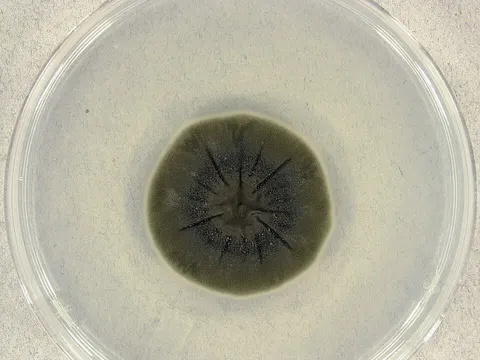
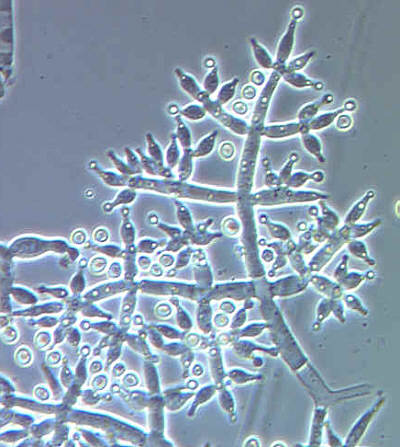
Trichoderma harzianum
A soil mould found worldwide and already used in agriculture as a biocontrol agent. It detoxifies cyanide through two enzymatic routes, and some strains isolated from contaminated sites grow on pyrene.
How it works
- Mechanisms
- mycodegradation
- Enzymes
- cyanide hydratase, rhodanese
Contaminants
| Contaminant | Evidence | What was shown |
|---|---|---|
| Cyanide | laboratory | Four strains of T. harzianum and one of T. pseudokoningii degrade cyanide through both the cyanide hydratase and the rhodanese routes (rhodanese KmCN 7-16 mM, pH optimum 8.5-10.5); beta-cyanoalanine synthase was not detected. A later paper by the same authors reports plant microcosm tests, of which only the title was consulted. |
| Polycyclic aromatic hydrocarbons | laboratory | A T. harzianum strain isolated from the soil of a former gasworks is one of five fungi able to degrade pyrene as sole carbon source in submerged culture (the other four are Penicillium). |
Limits
The main cyanide source is a PhD thesis; measurements are enzymatic and in culture. For pyrene the abstract gives no percentage for the Trichoderma strain. Use of Trichoderma in xenobiotic biodegradation remains limited compared with its use in biocontrol (Zafra & Cortés-Espinosa 2015). No field trial was found.
Sources
- Ezzi (2001) PhD thesis, University of Surrey (Europe PMC record), europepmc.org, 2001
- Ezzi & Lynch (2005) Biol Fertil Soils 42:40-44, 2005
- Saraswathy & Hallberg (2002) FEMS Microbiol Lett 210:227-232, 2002
- Zafra & Cortés-Espinosa (2015) Biodegradation of polycyclic aromatic hydrocarbons by Trichoderma species: a mini review. Environ Sci Pollut Res 22:19426-19433, 2015
Draft compiled from public sources, not yet reviewed.
Other species for the same contaminants
Species that the literature reports acting on at least one of this one's contaminants, the closest first.