Fungus, white rot
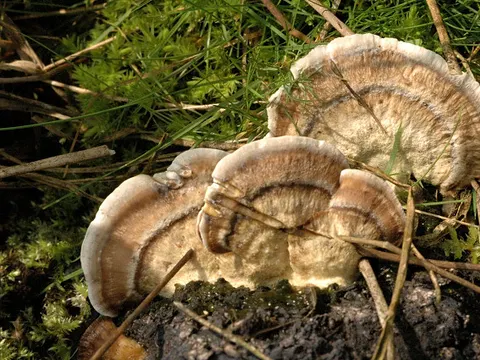
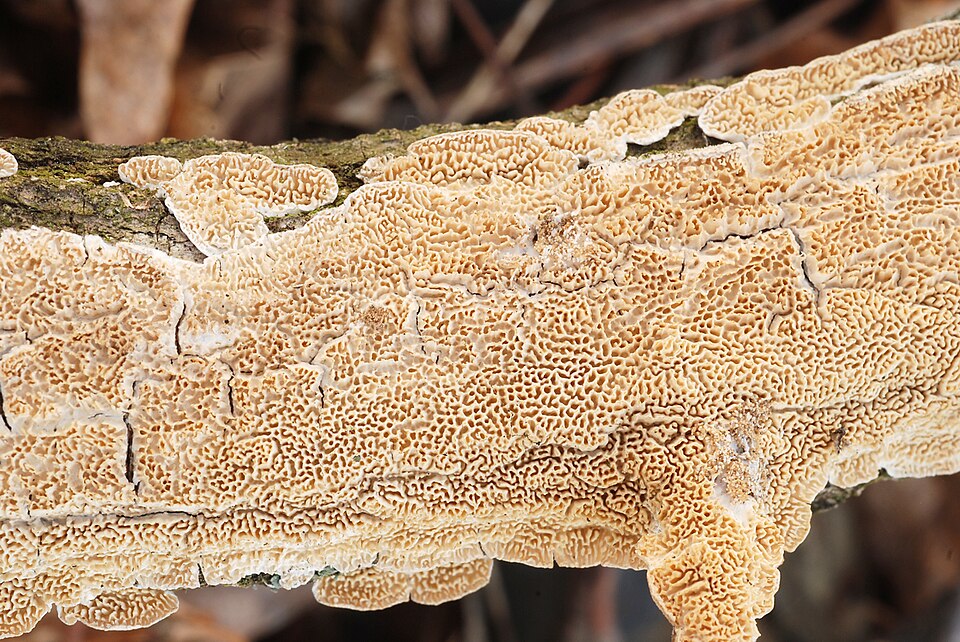
Irpex lacteus
Milk-white toothed polypore
A white-rot fungus studied mainly in Prague for its resistance to pollutant toxicity and its ability to colonise soil. In direct comparisons on real soils it degrades PAHs and PCBs, but generally less than Pleurotus ostreatus.
How it works
- Mechanisms
- mycodegradation
- Enzymes
- manganese peroxidase
Contaminants
| Contaminant | Evidence | What was shown |
|---|---|---|
| Polycyclic aromatic hydrocarbons | laboratory | Two industrial soils, 14 weeks: removal of fluorene 41 and 67%, phenanthrene 20 and 56%, anthracene 29 and 49%, fluoranthene 29 and 57%, pyrene 24 and 42%, chrysene 16 and 32%, benzo[a]anthracene 13 and 20%, with lower ecotoxicity (Vibrio fischeri, mustard germination). |
| Creosote | laboratory | Soil from a wood-preserving plant (50-200 mg/kg PAH), 120 days at 15 °C: 27-36% PAH removal (47-59% of 2-ring, 9-14% of 4-ring, 11-13% of 5-6-ring), against 55-67% for P. ostreatus. In a 56-day bench test on soil from a West Virginia site the two fungi gave similar results, up to 67.3% of total PAHs. |
| Polychlorinated biphenyls | laboratory | Long-term PCB-contaminated dumpsite soils, 12 weeks: the fungus oxidised and cleaved the PCB ring (hydroxylated and methoxylated PCBs and chlorobenzoates were found), but the best results were those of P. ostreatus. |
| Synthetic dyes | laboratory | A manganese peroxidase purified from strain CD2 decolorises azo, anthraquinone, indigo and triphenylmethane dyes and a simulated textile effluent, also in the presence of metal ions and organic solvents. |
Limits
All the trials found are laboratory or bench scale, although on real soils: we found no published field trial with measured data. 4-6-ring PAHs are poorly removed (9-14%). The fungus lowers soil bacterial biomass and stresses it more than P. ostreatus does (Byss et al. 2008), which may hold back the bacterial degradation expected to finish the job.
Where it has been tried
Czech Republic, wood-preserving plant (creosote soil)
MycoremediationLaboratory, with soil from the site
Pleurotus ostreatus, Irpex lacteus
Byss, Elhottová, Tříska and Baldrian incubated the soil with the two fungi at 15 °C for 120 days, following PAHs and the microbial community.
Outcome Pleurotus ostreatus removed 55–67% of PAHs, Irpex lacteus 27–36%. By class: 86–96% (Pleurotus) and 47–59% (Irpex) of 2-ring compounds, but only 31–38% and 11–13% of 5–6-ring ones. Both fungi lowered bacterial biomass. It is a laboratory trial.
Sources
- Novotný et al. (2009) Irpex lacteus, a white-rot fungus with biotechnological potential - review. Folia Microbiol 54:375-390, 2009
- Bhatt, Cajthaml & Šašek (2002) Folia Microbiol 47:255-258, 2002
- Byss et al. (2008) Chemosphere 73:1518-1523, 2008
- Lamar, White & Ashley (2002) Remediation Journal 12:97-106, 2002
- Stella et al. (2017) J Hazard Mater 324:701-710, 2017
- Qin et al. (2014) PLoS One 9:e113282, 2014
Draft compiled from public sources, not yet reviewed.
Other species for the same contaminants
Species that the literature reports acting on at least one of this one's contaminants, the closest first.