Fungus, litter decomposer
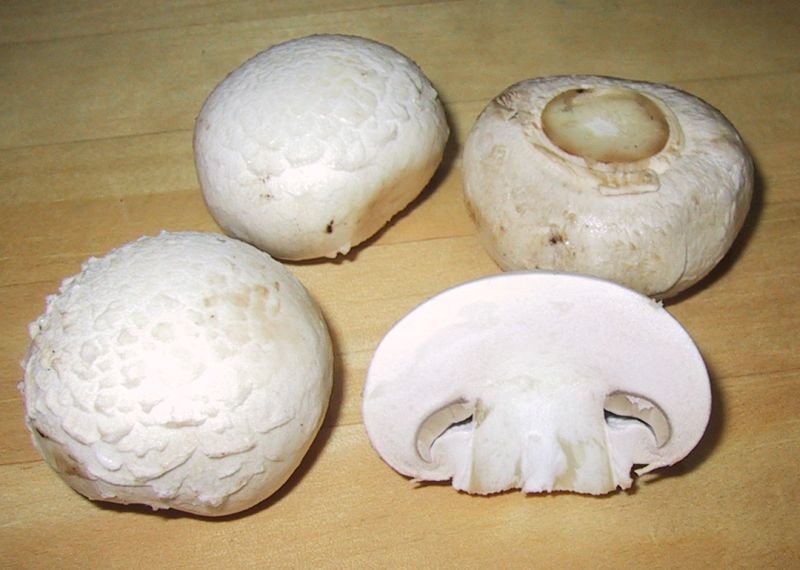
Agaricus bisporus
Button mushroom
The most widely cultivated mushroom, and its spent substrate is an abundant agro-industrial waste. Added to PAH-contaminated soil it acts in two distinct ways: as an amendment that stimulates soil bacteria, and as a carrier of the living fungus, which attacks the more condensed PAHs better.
How it works
- Mechanisms
- mycodegradation
Contaminants
| Contaminant | Evidence | What was shown |
|---|---|---|
| Polycyclic aromatic hydrocarbons | laboratory | Microcosms with historically PAH-polluted soil: natural attenuation did not work; sterilised spent substrate stimulated resident bacteria with high removal of 3-ring PAHs, while the two treatments with live fungus (substrate as such, or sterilised and re-inoculated with A. bisporus) were more effective on highly condensed PAHs. In soil near a shooting range, polluted with PAHs and Pb, the re-inoculated substrate was the best method to remove PAHs, mainly benzo[a]pyrene, and reduce ecotoxicity.
|
| Cadmium | laboratory | The fruiting body accumulates cadmium, more in the cap than in the stipe: up to 18.38 mg/kg dry weight at the closed-cup stage with 414.28 mg/kg Cd in the substrate. |
| Lead | laboratory | Spent substrate does not remove lead: in all three application modes it caused slight mobilisation (less than 0.3%). |
Limits
Laboratory microcosms only. Substrate used as such raises degrading bacteria but lowers fungal activity, so the two routes do not simply add up. Metals are not removed and may be slightly mobilised. Cadmium in the cap is far below that in the substrate (18 against 414 mg/kg): it is not a hyperaccumulator, and mushrooms grown on contaminated matrices are not edible. The enzymes responsible are not identified in the papers consulted (they report ligninolytic activity).
Sources
- García-Delgado et al. (2015) Sci Total Environ 508:20-28, 2015
- García-Delgado, Yunta & Eymar (2015) J Hazard Mater 300:281-288, 2015
- He, Zhang & Gao (2022) Sci Rep 12:20079, 2022
Draft compiled from public sources, not yet reviewed.
Other species for the same contaminants
Species that the literature reports acting on at least one of this one's contaminants, the closest first.