Plant, crop
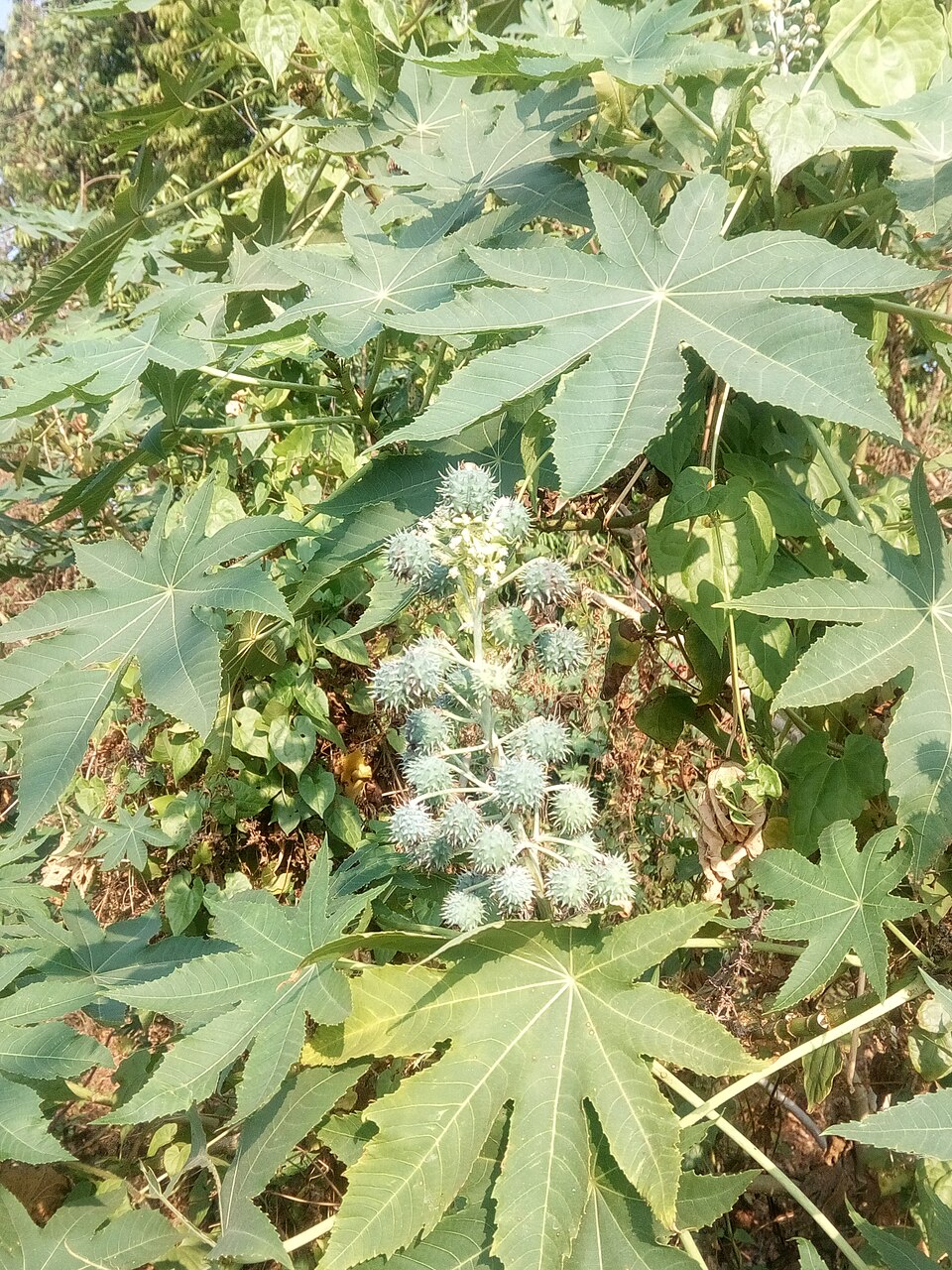
Ricinus communis
Castor bean
A fast-growing non-food oil plant that spontaneously colonises mine tailings. It does not accumulate metals in shoots: it serves to stabilise and to produce industrial oil; in pots it also took up DDT residues.
How it works
- Mechanisms
- phytostabilisationphytoextraction
Contaminants
| Contaminant | Evidence | What was shown |
|---|---|---|
| Lead | field | Wild plants on Mexican mine tailings rich in Cu, Zn, Mn, Pb and Cd: by shoot concentrations and translocation factors castor bean is not an accumulator; it suits stabilising the residues, and seeds hold 41 to 64% oil (Ruiz Olivares et al. 2013). |
| DDT and breakdown products | greenhouse | Pot trial with 23 genotypes on soil co-contaminated with DDT and cadmium: mean concentrations of DDT and derivatives of 0.37 (leaf), 0.43 (stem) and 70.51 mg/kg (root); total uptake from 83.1 to 267.8 µg per pot (Huang et al. 2011). |
| Cadmium | greenhouse | In the same pot trial: on average 1.22 (leaf), 2.27 (stem) and 37.63 mg/kg (root) Cd; uptake from 66.0 to 155.1 µg per pot (Huang et al. 2011). |
Limits
Contaminants stay almost entirely in the roots: real extraction is minimal. Seeds contain ricin and are highly toxic. Frost-sensitive. Oil content falls as root metal concentrations rise (Ruiz Olivares et al. 2013).
Sources
- Ruiz Olivares et al., J. Environ. Manage. 114:316, 2013
- Huang et al., Bioresour. Technol. 102:11034, 2011
Draft compiled from public sources, not yet reviewed.
Other species for the same contaminants
Species that the literature reports acting on at least one of this one's contaminants, the closest first.