Fungus, mycorrhizal
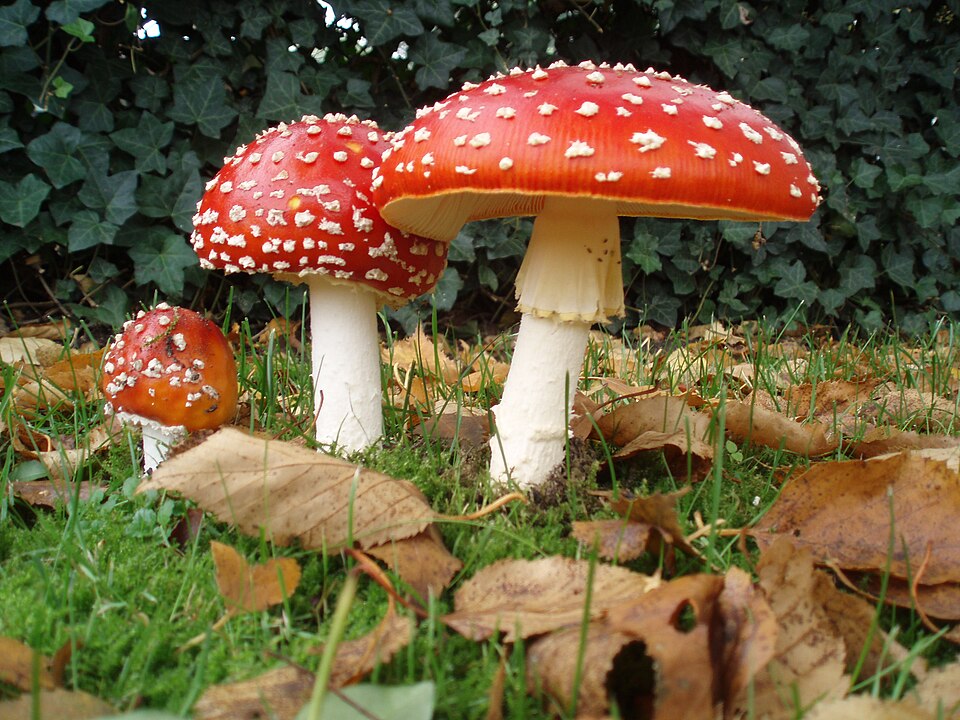
Amanita muscaria
Fly agaric
A poisonous ectomycorrhizal mushroom, known to chemists because it concentrates vanadium in its fruiting bodies as a natural complex, amavadin. It is not used in remediation: it is included as a case of selective metal accumulation and as a bioindicator.
How it works
- Mechanisms
- bioaccumulation
Contaminants
| Contaminant | Evidence | What was shown |
|---|---|---|
| Vanadium | survey of wild specimens | Measurements on wild mushrooms, not a remediation trial: in fruiting bodies collected at three distant sites in northern Poland vanadium medians fall in the 50-200 µg/g dry matter range, with similar concentrations in cap and stalk and significant differences between sites. |
| Cadmium | survey of wild specimens | In the same samples cadmium in caps has medians of 10-20 µg/g dry matter, higher in cap than in stalk. |
Limits
It cannot be cultivated without its host tree, is poisonous, and its fruiting-body biomass is negligible against the mass of soil: vanadium accumulation does not translate into an extraction technique. The evidence is observational. The determination of amavadin in this species is described in Braeuer et al. (2021), of which only the title and short abstract were consulted.
Sources
- Falandysz et al. (2007) J Environ Sci Health A 42:1615-1623, 2007
- Braeuer et al. (2021) Determination of the naturally occurring vanadium-complex amavadin in Amanita muscaria with HPLC-ICPMS, 2021
- Hubregtse et al. (2005) The first enantioselective synthesis of the amavadin ligand and its complexation to vanadium. J Inorg Biochem 99:1264-1267, 2005
Draft compiled from public sources, not yet reviewed.
Other species for the same contaminants
Species that the literature reports acting on at least one of this one's contaminants, the closest first.