Plant, herb
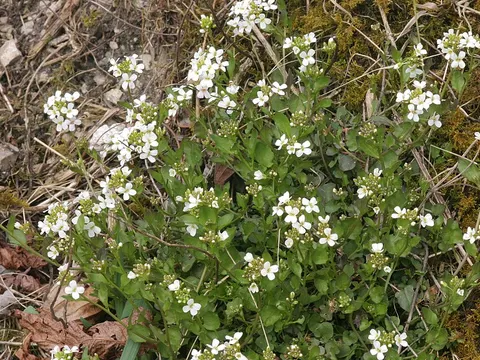
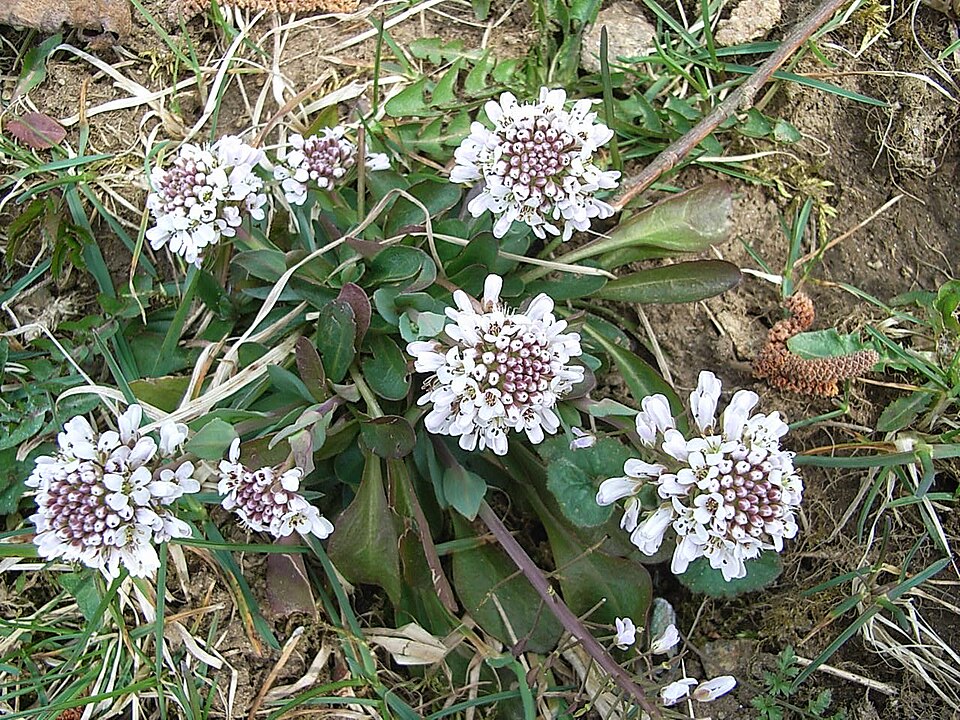
Noccaea caerulescens
Alpine pennycress
A small brassica (formerly Thlaspi caerulescens) that hyperaccumulates zinc and, in some populations, cadmium. It is the model species for hyperaccumulation research and one of the few field-tested for cadmium phytoextraction; its small biomass is the main constraint.
How it works
- Mechanisms
- hyperaccumulationphytoextraction
Contaminants
| Contaminant | Evidence | What was shown |
|---|---|---|
| Cadmium | field | Field trials in the UK (1998–2000): on average, on plots above limits, 1.3% of total soil Cd removed per season; 21.7% with a 14-month crop (McGrath et al. 2006). On urban soils with about 2 mg/kg Cd, uptake of up to 200 g Cd/ha (Jacobs et al. 2017). Cd accumulation differs sharply between populations: those from southern France (Ganges) accumulate far more than Prayon or Whitesike (Lombi et al. 2000).
|
| Zinc | field | In the same UK trials an average 0.3% of total soil Zn was removed per season (4.4% in 14 months) (McGrath et al. 2006); on urban soils up to 47 kg Zn/ha (Jacobs et al. 2017). Robinson et al. (1998) estimate 60 kg Zn and 8.4 kg Cd per hectare from a fertilised crop with 1.16% Zn and 0.16% Cd in dry matter, and conclude that cleaning soils high in zinc is not feasible within an economic timeframe. |
Limits
Low biomass (2.6 t/ha unfertilised in Robinson et al. 1998; up to 5 t/ha in the field in Jacobs et al. 2017), a rosette that is hard to harvest mechanically, shallow roots. Useful for soils moderately contaminated with Cd; not for high Zn. The choice of population is decisive, and the mobilising agents tested in the field did not raise accumulation (McGrath et al. 2006). Compost can immobilise metals and reduce extraction.
Where it has been tried
Switzerland, two contaminated soils (Thlaspi field trials)
PhytoremediationField scale
Noccaea caerulescens (Thlaspi caerulescens)
Hammer and Keller compared transplants repeated three times in eight months with two sowings over the same period.
Outcome Annual removal with transplants: 130 g/ha of cadmium and 3.7 kg/ha of zinc on the calcareous soil, 540 g/ha and 20 kg/ha on the acidic one. For cadmium the authors estimate clean-up in under ten years within Swiss limits; for zinc the soil content is too high for a realistic time span. The extractable fraction of the two metals did not fall.
Woburn Experimental Farm, sludge-treated plots
PhytoremediationField scale, 1998–2000
Noccaea caerulescens (Thlaspi caerulescens), Arabidopsis halleri
McGrath, Lombi, Zhao and colleagues (Rothamsted Research) field-tested two hyperaccumulators with mobilising agents, different sowing strategies and growing seasons of different length.
Outcome No mobilising agent raised accumulation. On average, between 1998 and 2000, Thlaspi removed 1.3% of total soil cadmium and 0.3% of zinc; in one 14-month season, 21.7% of the cadmium and 4.4% of the zinc. The authors judge the technique usable for soils moderately contaminated with cadmium, not for zinc.
Sources
- McGrath et al., Environ. Pollut. 141:115, 2006
- Robinson et al., Plant Soil 203:47, 1998
- Lombi et al., New Phytol. 145:11, 2000
- Jacobs et al., Environ. Sci. Pollut. Res. 24:8176, 2017
Draft compiled from public sources, not yet reviewed.
Other species for the same contaminants
Species that the literature reports acting on at least one of this one's contaminants, the closest first.