Plant, tree
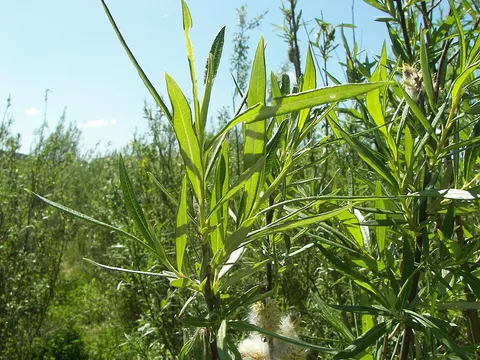
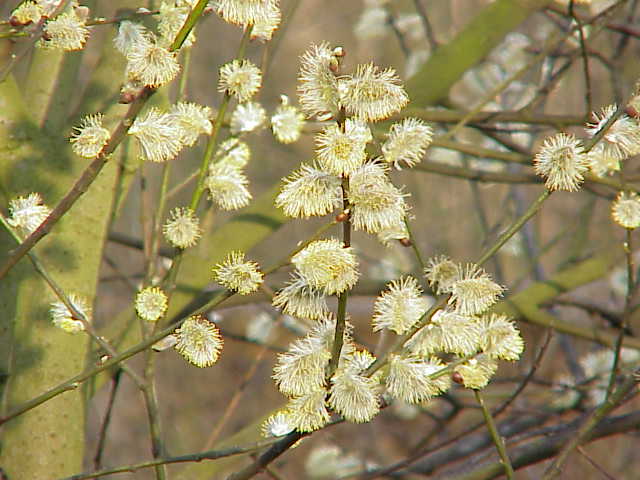
Salix caprea
Goat willow
A pioneer willow that spontaneously colonises mine dumps and industrial land. Among trees growing on contaminated sites in Central Europe it shows the highest leaf concentrations of cadmium and zinc.
How it works
- Mechanisms
- phytoextraction
Contaminants
| Contaminant | Evidence | What was shown |
|---|---|---|
| Cadmium | field | Survey of adult trees growing on contaminated sites in Central Europe: up to 116 mg/kg Cd in leaves of S. caprea; small year-to-year variation; lowest concentration in wood, rising towards leaves and fine roots (Unterbrunner et al. 2007). |
| Zinc | field | In the same survey up to 4,680 mg/kg Zn in leaves. Leaf concentrations are unrelated to total or labile soil content: the accumulation factor falls as soil concentration rises (Unterbrunner et al. 2007). |
Limits
The data are a survey of wild plants, not a clean-up trial with a mass balance of metal removed. Metal concentrates in the leaves, which on falling return it to the soil and expose herbivores. It roots from cuttings less readily than other willows.
Where it has been tried
Brescia-Caffaro
PhytoremediationGreenhouse, with soil from the site, 2015–2016
Festuca arundinacea, Phalaris arundinacea, Cucurbita pepo subsp. pepo, Medicago sativa, Brassica juncea, Salix caprea, Athyrium filix-femina
The University of Insubria, the University of Milan and ERSAF took about 2,500 kg of soil from the site and grew plants on it in a greenhouse for 18 months (May 2015 – November 2016) in 6 kg pots: ten treatments in triplicate with seven species, intercropping, compost, redox cycles and ammonium thiosulphate, with unplanted controls. It is a semi-field trial, not an open-field one.
Outcome After 18 months total PCBs had fallen by 14–20%. The best treatments (Festuca arundinacea with compost or intercropped with pumpkin; alfalfa with Rhizobium and mycorrhizal fungi) reached about 20%. For dioxins and furans tall fescue alone gave reductions of 11–24% depending on the congener, with half-lives of 2.5–5.8 years. The authors name the short duration, against the persistence of these compounds, as a limit.
- Terzaghi et al., Rhizoremediation of weathered PCBs in a heavily contaminated agricultural soil: results of a biostimulation trial in semi field conditions, Science of the Total Environment, 2019
- Terzaghi et al., New data set of PCDD/F half-lives: natural attenuation and rhizoremediation using several common plant species in a weathered contaminated soil, Environmental Science & Technology, pmc.ncbi.nlm.nih.gov, 2020
Sources
Draft compiled from public sources, not yet reviewed.
Other species for the same contaminants
Species that the literature reports acting on at least one of this one's contaminants, the closest first.