Fungus, mycorrhizal
Suillus luteus
Slippery jack
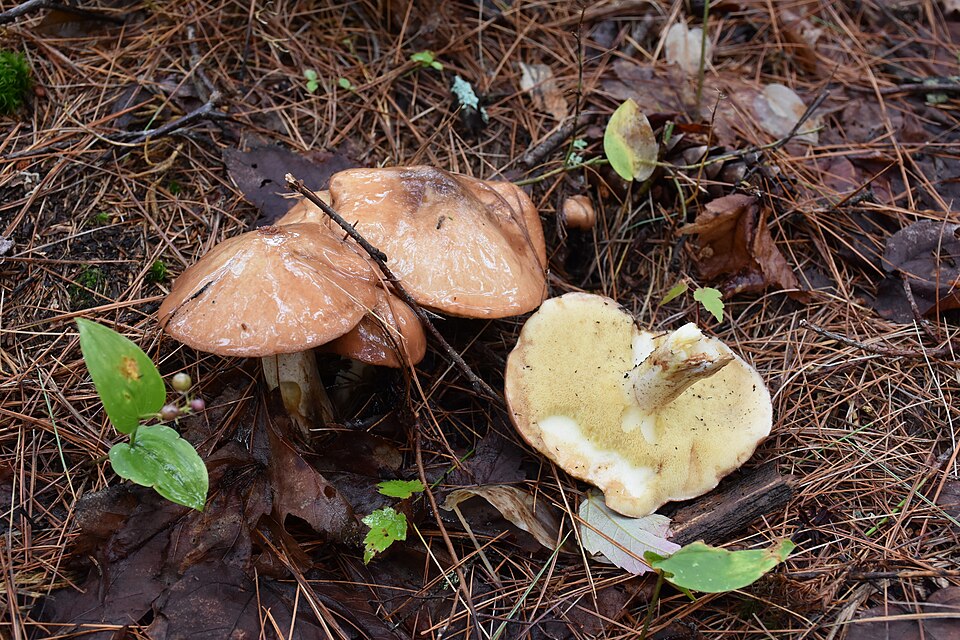
A pioneer ectomycorrhizal fungus of pines. Populations growing around Belgian zinc smelters and on a Norwegian copper mine spoil have evolved tolerance specific to the local metal, and adapted strains protect pine seedlings from toxicity: a documented case of adaptation usable for reforesting metalliferous sites.
How it works
- Mechanisms
- mycorrhizal supportphytostabilisation
Contaminants
| Contaminant | Evidence | What was shown |
|---|---|---|
| Zinc | laboratory | 235 isolates of four ectomycorrhizal species collected in pioneer pine forests at 14 locations along a Zn pollution gradient, tested in vitro (EC50 on biomass): Suilloid fungi within 5 km of a smelter are highly tolerant, those beyond 15 km are not, with mixed populations in between. Paxillus involutus shows no adaptive tolerance. |
| Copper | laboratory | Pinus sylvestris seedlings in a dose-response test: without mycorrhiza or with a copper-sensitive isolate, root growth and nutrient uptake are strongly inhibited; with the mine-spoil isolate plants are hardly affected by copper. Tolerance is metal-specific: Zn-tolerant isolates are Cu-sensitive and vice versa. |
| Cadmium | laboratory | Scots pines inoculated with a Cd-tolerant isolate from a polluted site: at high exposure more fungal biomass, higher nutrient uptake and less cadmium transferred to shoots than in plants with a sensitive isolate. |
Limits
The fungus protects the tree but does not take the metal out of the soil. There is no co-tolerance: the isolate adapted to the site's metal is needed, and a multi-metal site is a case not covered. Populations were collected in the field, but protection tests are on seedlings under controlled conditions. The fruiting bodies are edible and should not be picked on polluted sites.
Sources
- Colpaert et al. (2004) New Phytol 162:549-559, 2004
- Adriaensen et al. (2005) Appl Environ Microbiol 71:7279-7284, 2005
- Krznaric et al. (2009) Environ Pollut 157:1581-1588, 2009
Draft compiled from public sources, not yet reviewed.
Other species for the same contaminants
Species that the literature reports acting on at least one of this one's contaminants, the closest first.