Fungus, mycorrhizal
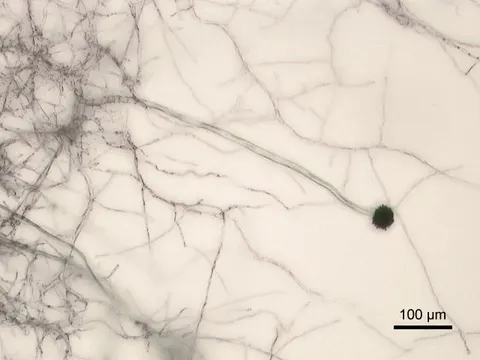
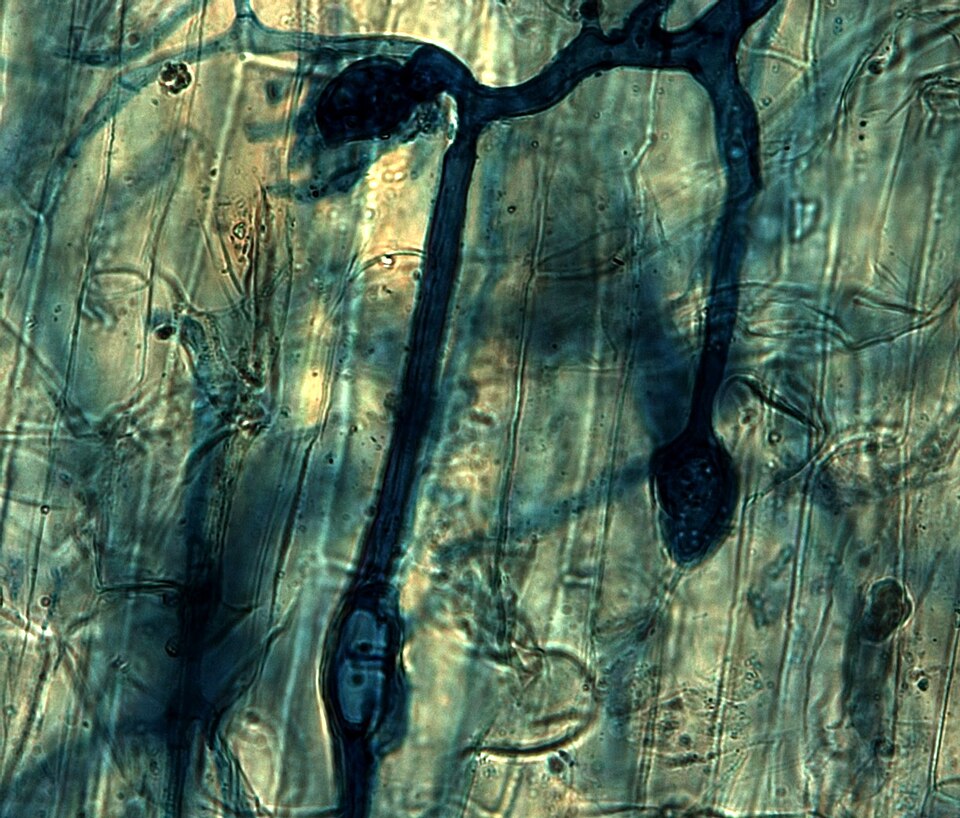
Rhizophagus irregularis
An arbuscular mycorrhizal fungus, Glomus intraradices in the older literature; it is the species most used in commercial inocula. It neither degrades nor extracts contaminants by itself: it changes the response of the host plant, which on metal-polluted soil grows more and retains more metal in its roots.
How it works
- Mechanisms
- mycorrhizal supportphytostabilisation
Contaminants
| Contaminant | Evidence | What was shown |
|---|---|---|
| Copper | greenhouse | White poplar cuttings (Populus alba, clone AL35) pre-inoculated with G. intraradices or G. mosseae and grown in pots on soil from a Cu- and Zn-polluted site: mycorrhiza restored biomass to normal despite higher Cu and Zn accumulation in plant organs, especially roots, with induction of foliar metallothionein and polyamine biosynthesis genes. |
| Zinc | greenhouse | Same trial: more zinc in the roots of mycorrhizal plants and growth restored; the authors conclude that the capacity to stabilise soil metals is increased. |
| Uranium | laboratory | Transformed carrot root cultures in two-compartment plates, with 0.1 µM 233U in the hyphae-only compartment: the mycelium takes up uranium and translocates it towards the roots, to an extent strongly dependent on pH. In a glasshouse, on mine-impacted soil with 111 mg/kg U, colonisation of Pteris vittata raised the U transfer factor to roots from 7 to 14, with less than 2% translocated to fronds.
|
Limits
The effect is stabilisation in roots, not extraction: the metal stays on site. With Pteris vittata colonisation depressed fern growth, particularly early on, and did not change tissue arsenic (Chen et al. 2006). An obligate symbiont: it cannot be grown without a host plant. The trials consulted are pot or in vitro experiments.
Where it has been tried
Sito metallurgico dismesso dell'Italia nord-occidentale (arsenico)
PhytoremediationField scale, 2014–2017
Pteris vittata, Rhizophagus spp., Funneliformis spp.
The University of Eastern Piedmont (Cantamessa, Massa, Gamalero, Berta) grew the fern Pteris vittata, inoculated or not with arbuscular mycorrhizal fungi, first for two years in a greenhouse on soil from the site and then for three years on the site itself, from March 2014, measuring arsenic at two depths.
Outcome In the greenhouse soil arsenic fell from 170 to 49 mg/kg with mycorrhizal ferns. In the field, by the third year, nearly all sub-areas were below 50 mg/kg in the 0–0.2 m layer (one stayed above the limit); fronds held 835 mg/kg of As on average. Between 0.2 and 0.4 m the decline was slower, which the authors put down to cadmium toxicity.
Sources
- Cicatelli et al. (2010) Ann Bot 106:791-802, 2010
- Rufyikiri et al. (2002) New Phytol 156:275-281, 2002
- Chen, Zhu & Smith (2006) Chemosphere 62:1464-1473, 2006
Draft compiled from public sources, not yet reviewed.
Other species for the same contaminants
Species that the literature reports acting on at least one of this one's contaminants, the closest first.