Plant, crop
Helianthus annuus
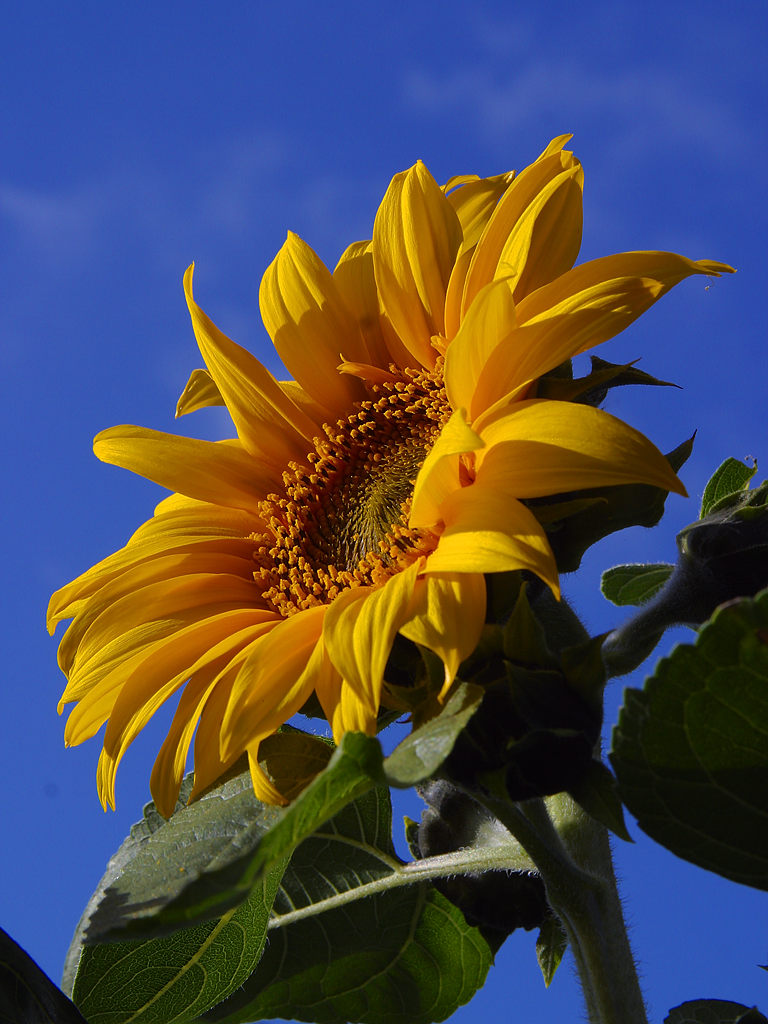
Sunflower
A high-biomass oil crop. It is known for rhizofiltration: roots held in water on rafts retain uranium and other metals. From soil it extracts modest amounts of metals; in Italy it was field-tested at Torviscosa.
How it works
- Mechanisms
- rhizofiltrationphytoextraction
Contaminants
| Contaminant | Evidence | What was shown |
|---|---|---|
| Uranium | field | Rhizofiltration of uranium from water using terrestrial plants, sunflower and Indian mustard, including a pilot test on water from a former uranium processing plant at Ashtabula, Ohio (Dushenkov et al. 1997). The method had been developed two years earlier for lead and other metals (Dushenkov et al. 1995). |
| Zinc | field | Field trial from 2005 at Torviscosa (Udine), on an industrial site polluted by pyrite cinders and placed on the national priority list in 2001 (soil: As 309, Cd 4.29, Co 50.9, Cu 1,527, Zn 980 mg/kg): zinc removal of about 1,000 g/ha with sunflower and 2,000 g/ha with sorghum; fertiliser and amendment raised biomass but not metal concentration in tissues (Marchiol et al. 2007). |
Limits
From soil, removal is on the order of a kilogram of zinc per hectare per year: against hundreds of mg/kg in soil, clean-up times are very long. Rhizofiltration treats water, not soil, and leaves contaminated roots to dispose of. The use of sunflowers in ponds near Chernobyl is often cited, but no verifiable primary source for its results was found, so it is not quantified here.
Where it has been tried
Ashtabula, former uranium processing facility
PhytoremediationField pilot
Helianthus annuus
Dushenkov and colleagues selected in the laboratory sunflowers whose roots concentrate uranium (bioaccumulation coefficients up to 30,000) and then tested a pilot rhizofiltration system on site, in which contaminated water flows through the roots.
Outcome The pilot system brought uranium below 20 µg/L before discharge. Nearly all the uranium stayed in the roots. It is a trial on water, not on soil.
Caffaro di Torviscosa (formerly Grado and Marano Lagoon)
PhytoremediationField scale
Helianthus annuus, Medicago sativa, Raphanus sativus var. oleiformis, Lolium multiflorum
Sunflower, alfalfa, fodder radish and Italian ryegrass grown in the field on pyrite cinders capped with 0.15 m of clean soil, comparing ploughing with subsoiling to 0.3 m. Ploughing brought about 30% more contamination into the topsoil.
Outcome Removal in the shoots was poor: at most 33 mg/m² of trace elements, 62% of it zinc and 18% copper. Fodder radish and sunflower gave the most biomass. Fine roots in the shallow layers were a large sink for the elements, useful for phytostabilisation.
PhytoremediationField scale, 2005
Sorghum bicolor, Helianthus annuus
The University of Udine (Marchiol, Fellet, Perosa, Zerbi) grew sorghum and sunflower in randomised blocks on soil with As 309, Cd 4.29, Co 50.9, Cu 1,527 and Zn 980 mg/kg, comparing mineral fertiliser, organic amendment and a control, with relief irrigation.
Outcome Fertiliser and amendment raised biomass a great deal but not the metal concentration in the harvested tissue; in some cases organic matter made the elements less available. Zinc removal was about 2,000 g/ha with sorghum and 1,000 g/ha with sunflower: small amounts against what the soil holds.
Fukushima Daiichi and its fallout area
PhytoremediationField scale, 2011
Helianthus annuus
Trial by Japan's Ministry of Agriculture (MAFF): sunflowers grown on contaminated fields in Iitate and Kōriyama to see whether they would take up radioactive caesium from the soil. It was part of a set of farmland decontamination trials whose results were released on 14 September 2011.
Outcome It failed. With soil at 1,045 Bq/kg (Kōriyama) and 7,715 Bq/kg (Iitate), stems and flowers held 12–79 Bq/kg and roots 64–232 Bq/kg (fresh weight). The caesium sat in the top few centimetres of soil, while sunflower roots reach below one metre. MAFF concluded that plants could not be relied on for decontamination and abandoned the method.
- Amano O. Results of Removing Radioactive Cesium from the Shallow Rice Fields by Planting Sunflower (quotes the MAFF results). Insights Concerning the Fukushima Daiichi Nuclear Accident, vol. 2, aesj.net, 2021
- Sunflowers next to useless for nuclear decontamination (Asahi Shimbun, 16 September 2011, archived), jdarchive.org, 2011
PhytoremediationField scale, 2012
Helianthus annuus
After the MAFF result, a team led by Osamu Amano (Japan Atomic Energy Agency) had farmers in two districts of Minamisōma grow sunflowers on shallow fields that were tilled first to spread the caesium through the soil, measuring caesium in roots, stems and soil over time.
Outcome The report states that uptake was highest during the most vigorous growth, just before flowering. The amounts removed were not checked for this record.
Porto Marghera (Venice)
PhytoremediationField scale
Helianthus annuus, Brassica juncea
In-situ phytoextraction of cadmium, mercury and zinc inside the Porto Marghera industrial area, using two high-biomass crops, sunflower and Indian mustard. The paper reports early results of the ongoing trial and the microcosm and mesocosm tests used to choose the treatments.
Outcome Using EDTA and ammonium thiosulphate together during phytoextraction raised the removal efficiency of Cd, Hg and Zn from the soil (the abstract gives no figures).
Chernobyl Exclusion Zone
PhytoremediationField pilot
Helianthus annuus
Rhizofiltration demonstration in a pond near the plant: sunflowers grown on floating rafts with their roots in the water, to remove caesium-137 and strontium-90.
Outcome The University of Hawaii fact sheet reports a 90% reduction in two weeks, with roots concentrating the radionuclides up to 8,000-fold. The review by Lincoln and Noori (2025) notes that after nearly forty years of physical, chemical and biological attempts the contamination persists.
Sources
- Dushenkov et al., Environ. Sci. Technol. 31:3468, 1997
- Dushenkov et al., Environ. Sci. Technol. 29:1239, 1995
- Marchiol et al., Plant Physiol. Biochem. 45:379, 2007
Draft compiled from public sources, not yet reviewed.
Other species for the same contaminants
Species that the literature reports acting on at least one of this one's contaminants, the closest first.