Plant, grass
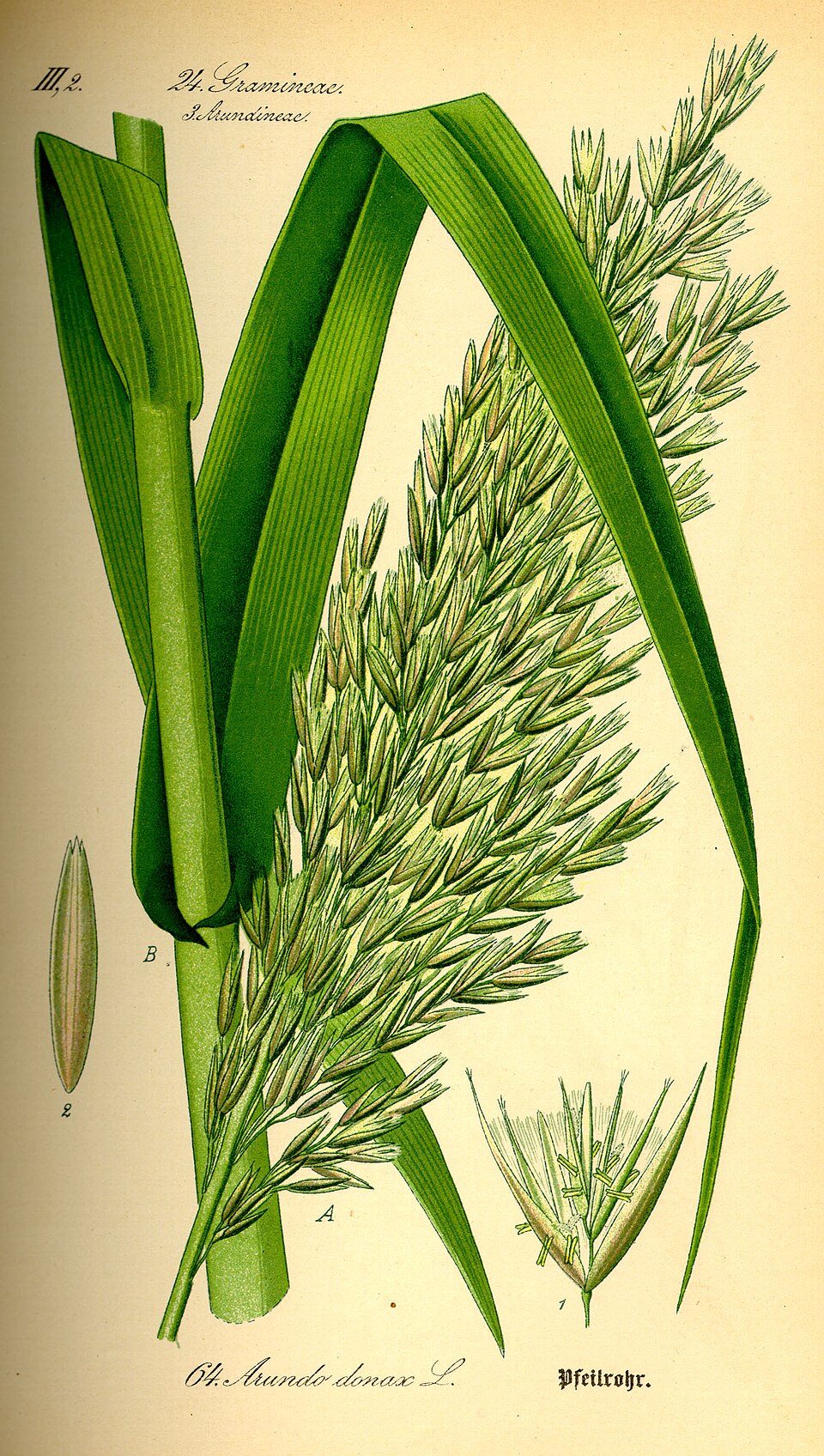
Arundo donax
Giant reed
A large perennial reed, highly productive and tolerant of pollutants. On industrial soils it keeps lead and zinc in its rhizomes and leaves the aerial part clean and usable as biomass. It has been studied at length in Campania.
How it works
- Mechanisms
- phytostabilisationphytoextractionrhizofiltration
Contaminants
| Contaminant | Evidence | What was shown |
|---|---|---|
| Lead | greenhouse | Two-year open-air lysimeter study on industrial substrates polluted by Pb and Zn (University of Naples): above-ground growth only 16% lower than on unpolluted soil; shoots do not accumulate the metals, rhizomes do; humic acids improved tolerance and yield (Fiorentino et al. 2017). |
| Zinc | greenhouse | In the same study zinc accumulates in rhizomes and not in above-ground biomass (Fiorentino et al. 2017). |
| Arsenic | greenhouse | In nutrient solution with 50–1,000 µg/L As for 21 days: no toxicity symptoms up to 600 µg/L, oxidative stress at 1,000 µg/L (Mirza et al. 2010). |
Limits
It is among the world's hundred worst invasive alien species according to the Global Invasive Species Database: it forms pure stands along watercourses, alters hydrology and fire regime and spreads by rhizome fragments. It should be used away from water and with control of the rhizomes. Metals end up in the rhizomes: removing them means digging these out, which is costly; otherwise it is stabilisation.
Sources
- Fiorentino et al., Sci. Total Environ. 575:1375, 2017
- Mirza et al., Bioresour. Technol. 101:5815, 2010
- Arundo donax, Global Invasive Species Database, IUCN ISSG
Draft compiled from public sources, not yet reviewed.
Other species for the same contaminants
Species that the literature reports acting on at least one of this one's contaminants, the closest first.