Plant, crop
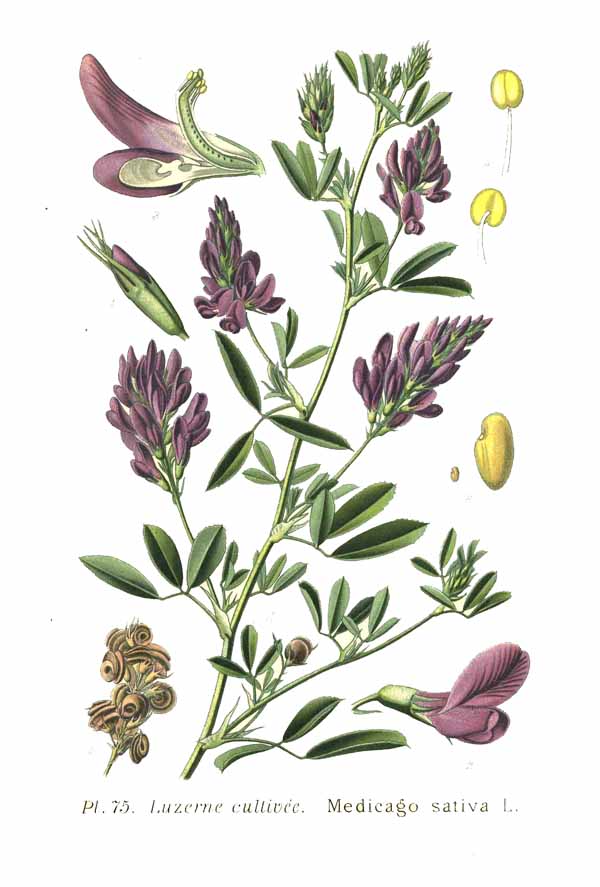
Medicago sativa
Alfalfa, lucerne
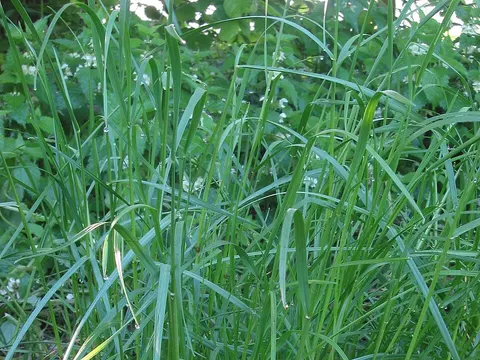
A deep-rooted perennial forage legume that fixes nitrogen and sustains abundant microbial life in its rhizosphere. It is used to stimulate the breakdown of hydrocarbons and PCBs in soil; the effect comes from the rhizosphere, not from uptake.
How it works
- Mechanisms
- rhizodegradation
Contaminants
| Contaminant | Evidence | What was shown |
|---|---|---|
| Polychlorinated biphenyls | field | A 180-day field trial on farmland with weathered PCBs: alfalfa alone lowered soil PCBs by 8.1%; inoculated with Rhizobium meliloti by 33.8%, and with Rhizobium plus the mycorrhizal fungus Glomus caledonium by 43.5% (Teng et al. 2010). In pots, with Aroclor 1248 at 100 mg/kg, 38% or less of the initial PCBs was recovered from planted pots against more than 82% from controls (Chekol et al. 2004).
|
| Petroleum hydrocarbons | field | At ten refinery sites (13.7 g/kg hydrocarbons on average), alfalfa and ryegrass with nitrogen fertiliser and tillage: 72–90% decontamination in a year; with natural vegetation alone the same result took five years (Panchenko et al. 2023). In a greenhouse, with 20 g/kg crude oil, degradation after one year ranged among genotypes from 33 to 56%, against 46% for the unvegetated control: only two of twenty genotypes did better than bare soil (Wiltse et al. 1998). |
| Polycyclic aromatic hydrocarbons | greenhouse | In pots, 60 days: 69–85% of spiked pyrene gone from rhizosphere soil against 59–80% outside it, six percentage points more on average; at 492 mg/kg pyrene shoot biomass fell to 34% (Fan et al. 2008). |
Limits
The gain due to the plant is often small against unplanted soil (a few percentage points for pyrene, 8% for PCBs without inoculum) and depends on genotype and associated microbes. In field trials on hydrocarbons it is hard to separate the plant's effect from that of fertiliser and tillage. In heavily contaminated soil yield falls to a third (Wiltse et al. 1998). Forage grown on PCB soil must not be fed to livestock.
Where it has been tried
Brescia-Caffaro
PhytoremediationGreenhouse, with soil from the site
Festuca arundinacea, Cucurbita pepo subsp. pepo, Medicago sativa, Phalaris arundinacea
Greenhouse rhizoremediation trial on farm soil from the SIN contaminated with aged PCBs (mg/kg range), in 6 kg pots to approach field conditions. Ten treatments in triplicate: seven species (grasses and trees) and five growing conditions (single species, intercropping, redox cycle by flooding, added compost or ammonium thiosulfate), with unplanted controls, for 18 months. The same experiment produced soil half-lives for PCBs and for dioxins and furans.
Outcome After 18 months total PCBs had fallen by 14–20%. The best treatments (about 20%) were Festuca arundinacea with compost, Festuca arundinacea grown with Cucurbita pepo, and Medicago sativa with Rhizobium and mycorrhizal fungi. PCB half-lives ranged from 1.3 to 5.6 years. For dioxins and furans only Festuca arundinacea gave a significant reduction (11–24% depending on the congener; half-lives 2.5–5.8 years). In a later column test, soil grown with Medicago sativa released about twice as much PCB in leachate, bound to particulate organic carbon.
- Terzaghi E. et al. Rhizoremediation of weathered PCBs in a heavily contaminated agricultural soil: results of a biostimulation trial in semi field conditions. Science of the Total Environment 686:484-496, 2019
- Terzaghi E. et al. A new dataset of PCB half-lives in soil: effect of plant species and organic carbon addition on biodegradation rates in a weathered contaminated soil. Science of the Total Environment 750:141411, 2021
- Terzaghi E. et al. New data set of polychlorinated dibenzo-p-dioxin and dibenzofuran half-lives: natural attenuation and rhizoremediation using several common plant species in a weathered contaminated soil. Environmental Science & Technology 54:10000-10011, 2020
- Terzaghi E. et al. Plants radically change the mobility of PCBs in soil: role of different species and soil conditions. Journal of Hazardous Materials 388:121786, 2020
Microbial bioremediationLaboratory, with soil from the site
Medicago sativa, Centaurea nigrescens, Dactylis glomerata
Study of the bacteria associated with the roots of three spontaneous plants (Medicago sativa, Centaurea nigrescens, Dactylis glomerata) growing in a former farm field of the SIN after cultivation was banned. Communities described by 16S rRNA gene sequencing; 165 rhizosphere isolates able to grow on biphenyl tested for plant growth promotion and degradation potential.
Outcome Soil fraction and plant species explained 21% and 18% of the variation in the bacterial microbiome. The bphA gene (biphenyl dioxygenase) was present in the soil metagenome. Eleven isolates tested on tomato confirmed the plant growth promotion and protection effect.
PhytoremediationGreenhouse, with soil from the site, 2015–2016
Festuca arundinacea, Phalaris arundinacea, Cucurbita pepo subsp. pepo, Medicago sativa, Brassica juncea, Salix caprea, Athyrium filix-femina
The University of Insubria, the University of Milan and ERSAF took about 2,500 kg of soil from the site and grew plants on it in a greenhouse for 18 months (May 2015 – November 2016) in 6 kg pots: ten treatments in triplicate with seven species, intercropping, compost, redox cycles and ammonium thiosulphate, with unplanted controls. It is a semi-field trial, not an open-field one.
Outcome After 18 months total PCBs had fallen by 14–20%. The best treatments (Festuca arundinacea with compost or intercropped with pumpkin; alfalfa with Rhizobium and mycorrhizal fungi) reached about 20%. For dioxins and furans tall fescue alone gave reductions of 11–24% depending on the congener, with half-lives of 2.5–5.8 years. The authors name the short duration, against the persistence of these compounds, as a limit.
- Terzaghi et al., Rhizoremediation of weathered PCBs in a heavily contaminated agricultural soil: results of a biostimulation trial in semi field conditions, Science of the Total Environment, 2019
- Terzaghi et al., New data set of PCDD/F half-lives: natural attenuation and rhizoremediation using several common plant species in a weathered contaminated soil, Environmental Science & Technology, pmc.ncbi.nlm.nih.gov, 2020
Caffaro di Torviscosa (formerly Grado and Marano Lagoon)
PhytoremediationField scale
Helianthus annuus, Medicago sativa, Raphanus sativus var. oleiformis, Lolium multiflorum
Sunflower, alfalfa, fodder radish and Italian ryegrass grown in the field on pyrite cinders capped with 0.15 m of clean soil, comparing ploughing with subsoiling to 0.3 m. Ploughing brought about 30% more contamination into the topsoil.
Outcome Removal in the shoots was poor: at most 33 mg/m² of trace elements, 62% of it zinc and 18% copper. Fodder radish and sunflower gave the most biomass. Fine roots in the shallow layers were a large sink for the elements, useful for phytostabilisation.
Hinkley groundwater contamination
PhytoremediationField scale
Medicago sativa
Alfalfa cultivation as part of treating the contaminated water. Wikipedia lists the method without dates, areas or results; to be checked against the regional water board's documents.
- Hinkley groundwater contamination, en.wikipedia.org, 2026
Sources
- Teng et al., Int. J. Phytoremediation 12:516, 2010
- Chekol et al., Environ. Int. 30:799, 2004
- Panchenko et al., Life 13:177, 2023
- Wiltse et al., J. Environ. Qual. 27:169, agris.fao.org, 1998
- Fan et al., Chemosphere 71:1593, 2008
Draft compiled from public sources, not yet reviewed.
Other species for the same contaminants
Species that the literature reports acting on at least one of this one's contaminants, the closest first.