Plant, tree
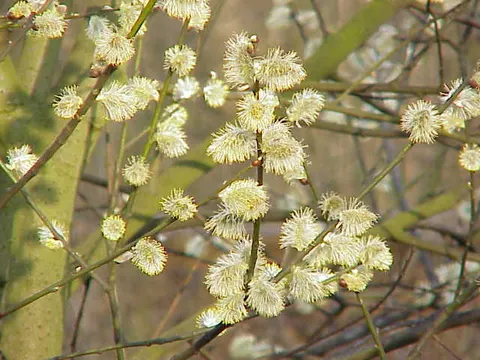
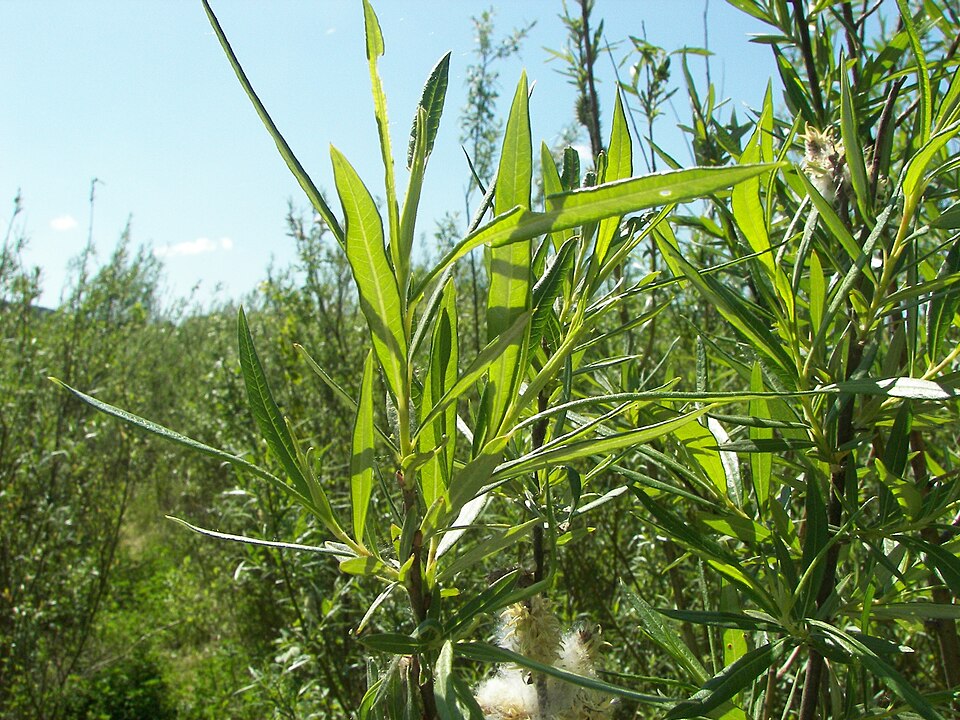
Salix viminalis
Basket willow, common osier
A fast-growing willow grown as short-rotation coppice for biomass. It accumulates cadmium and zinc in leaves and bark more than other woody plants and is the tree species with the most field evidence for cadmium phytoextraction from farmland.
How it works
- Mechanisms
- phytoextractionphytostabilisation
Contaminants
| Contaminant | Evidence | What was shown |
|---|---|---|
| Cadmium | field | In Sweden four years of cropping lowered soil Cd by up to 27% and Cd in the grain of wheat grown afterwards by up to 33%, an effect stable for years (Greger and Landberg 2015). On a dredged-sediment disposal site in Belgium, clone 'Orm' yielded 13.2–17.8 t/ha/year dry matter and removed 83 g Cd/ha/year (Meers et al. 2005). Five-year field trials in Switzerland are in Hammer et al. (2003).
|
| Zinc | field | On the same sediment site: 5,034 g Zn/ha/year, against 145 g Cu, 83 g Pb, 12 g Ni and 6 g Cr (Meers et al. 2005). |
Limits
It works for cadmium and zinc, little or not at all for lead, copper, nickel and chromium. Meers et al. (2005) rate the removal obtained as low. Much of the metal is in the leaves: if they fall and stay on the ground, the metal returns to the surface; they must be collected or the cut made before leaf fall. Large differences between clones. Contaminated wood must be burned in plants with filters and the ash disposed of.
Where it has been tried
Sweden, cadmium-enriched arable soils (Salix)
PhytoremediationField scale
Salix viminalis, Triticum aestivum
Greger and Landberg grew Salix viminalis for four years at different densities and then sowed wheat on the same fields.
Outcome Four years of willow lowered soil cadmium by up to 27% and cadmium in the grain of the following wheat by up to 33%; the effect grew with planting density and held for several years.
Sources
- Greger and Landberg, Int. J. Phytoremediation 17:917, 2015
- Meers et al., Environ. Pollut. 137:354, 2005
- Hammer et al., Soil Use Manage. 19:187, 2003
Draft compiled from public sources, not yet reviewed.
Other species for the same contaminants
Species that the literature reports acting on at least one of this one's contaminants, the closest first.