Plant, tree
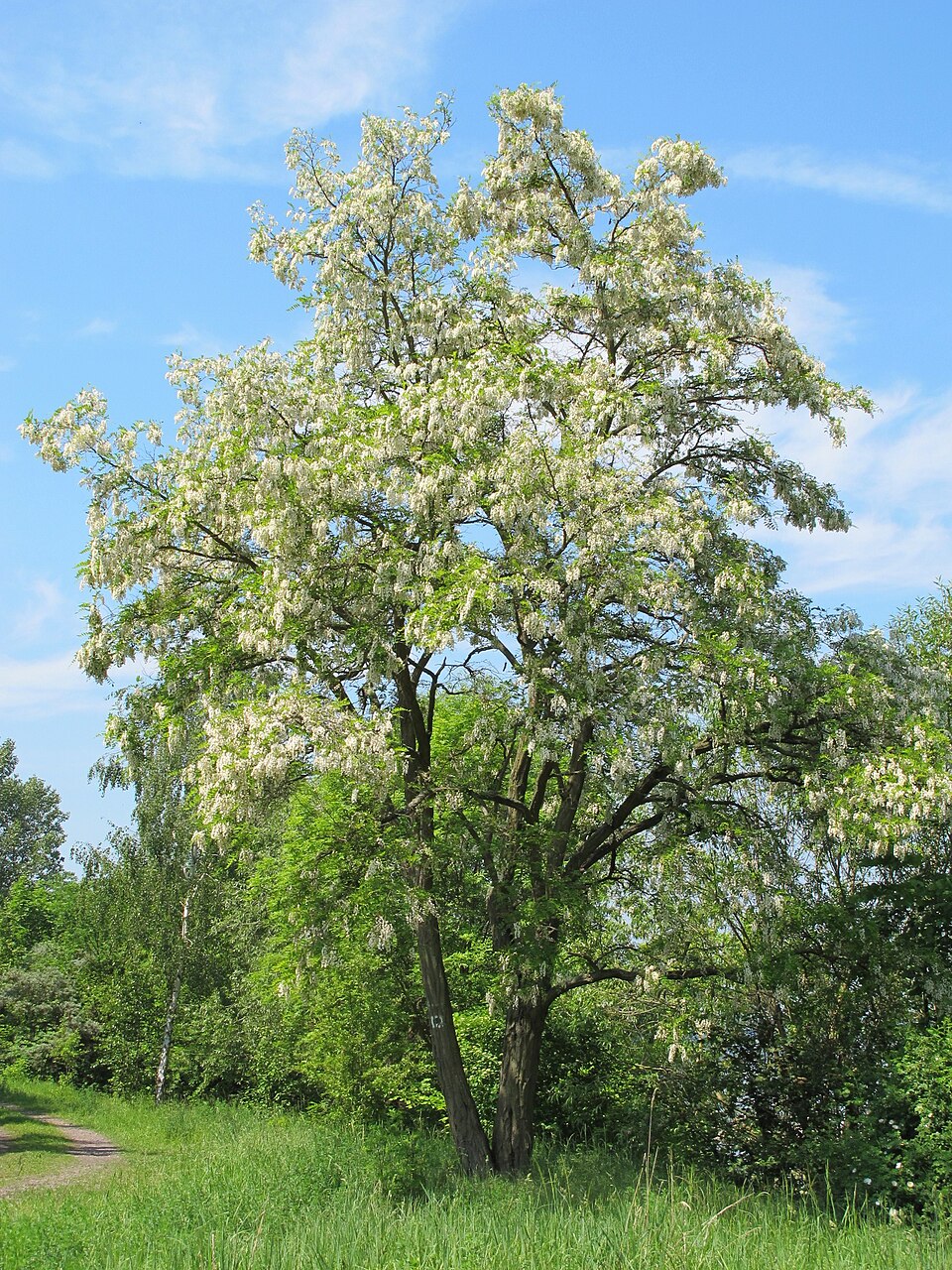
Robinia pseudoacacia
Black locust
A pioneer leguminous tree that fixes nitrogen and grows on poor soils and mine tailings. It behaves as an excluder: it moves little metal to leaves and twigs, which is why it has been used to afforest heavily contaminated soils. In Europe, however, it is invasive.
How it works
- Mechanisms
- phytostabilisation
- Native range
- Eastern North America (Appalachians)
Contaminants
| Contaminant | Evidence | What was shown |
|---|---|---|
| Cadmium | field | Eight-year field trial in northern France on former farmland heavily contaminated by Cd, Pb and Zn, afforested with a tree mix with or without fly ash: black locust, black alder and sycamore grew well with low metal concentrations in leaves and young twigs (an excluder phenotype), unlike white willow and pedunculate oak; with fly ash metal availability and translocation to above-ground parts fell sharply (Pourrut et al. 2011). |
| Lead | field | It grows wild on the lead-zinc tailings of the abandoned Touissit mines (eastern Morocco), with a rhizosphere rich in metal-resistant growth-promoting bacteria (Bennis et al. 2022). |
Limits
It does not extract: metals stay in the soil. In Central Europe it is considered invasive: it threatens dry and semi-dry grasslands above all, changes light, microclimate and soil, and resprouts from roots after cutting (Vítková et al. 2017). It enriches soil with nitrogen, which can favour other unwanted species. Planting near protected habitats should be avoided.
Where it has been tried
Metaleurop Nord (Noyelles-Godault)
PhytoremediationField scale, 1999–
Miscanthus × giganteus, Robinia pseudoacacia, Alnus glutinosa, Quercus robur, Acer pseudoplatanus, Salix alba
The PHYTENER project (ISA Lille and ten other laboratories, funded by ADEME): one hectare planted in 1999 with about 1,800 trees of five species, 600 m north of the smelter; three fields of about one hectare under miscanthus since 2007 on soils with different contamination levels, and a fourth since 2010 to test cultivars, planting density, fertilisation and mycorrhizae.
Outcome Miscanthus accumulates the metals mainly in its roots and passes little to the stems: yields rose from 3.7–10.3 t/ha of dry matter in the second year to 15.8–23.3 t/ha in the third. This is phytostabilisation with biomass production: the metals stay in the soil.
- Nsanganwimana et al., Metal accumulation and shoot yield of Miscanthus × giganteus growing in contaminated agricultural soils: insights into agronomic practices, Agriculture, Ecosystems & Environment, 2015
- Pourrut et al., The PHYTENER project: development of phytostabilisation combined with energy crop production on agricultural soils highly contaminated by metals, EGU General Assembly, meetingorganizer.copernicus.org, 2011
Sources
- Pourrut et al., Sci. Total Environ. 409:4504, 2011
- Bennis et al., J. Environ. Manage. 304:114321, 2022
- Vítková et al., Black locust (Robinia pseudoacacia) beloved and despised: a story of an invasive tree in Central Europe, For. Ecol. Manage. 384:287, 2017
Draft compiled from public sources, not yet reviewed.
Other species for the same contaminants
Species that the literature reports acting on at least one of this one's contaminants, the closest first.