Plant, herb
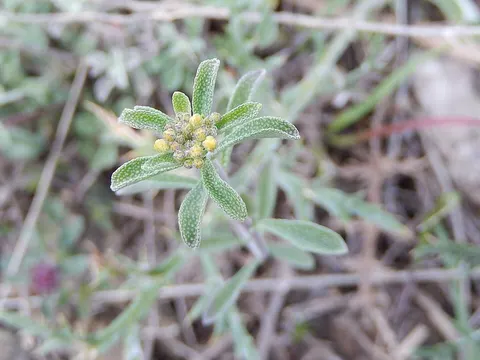
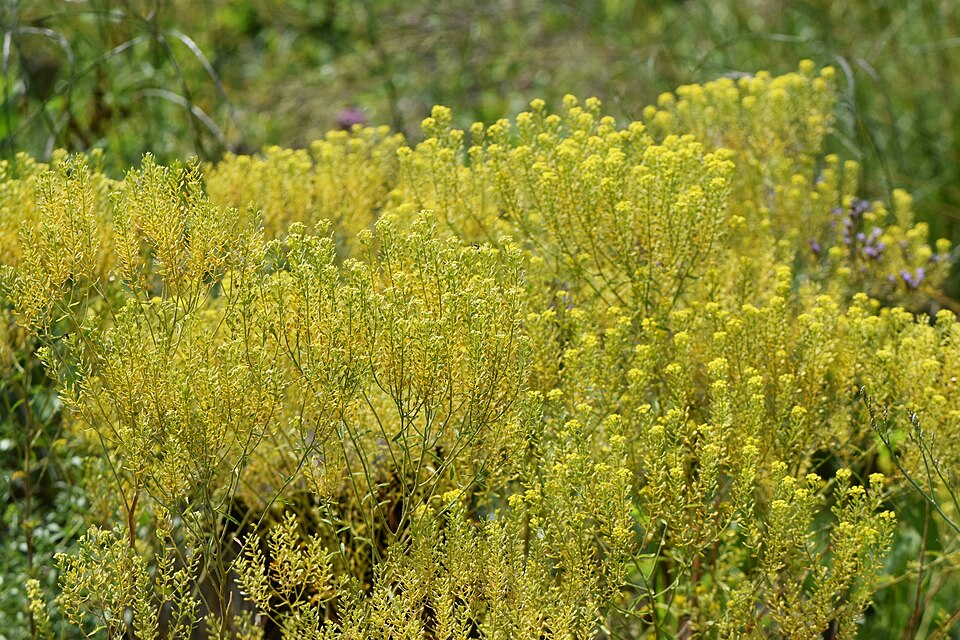
Odontarrhena chalcidica
Yellowtuft
A serpentine brassica, known in the literature as Alyssum murale, that hyperaccumulates nickel. It is the reference crop of nickel agromining: grown on ultramafic soils, harvested, and the metal recovered from the ash.
How it works
- Mechanisms
- hyperaccumulationphytoextraction
- Native range
- Ultramafic (serpentine) soils of the Balkans, including Albania
Contaminants
| Contaminant | Evidence | What was shown |
|---|---|---|
| Nickel | field | Five years of trials in Albania on an ultramafic Vertisol: with fertilisation and sowing, biomass yield rose from 0.3 to 9.0 t/ha and nickel extracted from 1.7 to 105 kg/ha (Bani et al. 2015). With manure, 145 kg Ni/ha in a later trial (Bani and Echevarria 2019). In a temperate climate, on Austrian serpentine, up to 55 kg Ni/ha (Rosenkranz et al. 2019).
|
Limits
The high yields come from ultramafic soils naturally rich in available nickel, in a Mediterranean climate; on Austrian serpentine yields were lower (20–55 kg Ni/ha) (Rosenkranz et al. 2019; Hipfinger et al. 2021). It needs fertiliser and weed control. It is a metal-recovery technique more than a clean-up one: how it performs on industrially contaminated soils is not covered by the sources consulted.
Where it has been tried
Pojskë, ultramafic Vertisol (nickel agromining)
PhytoremediationField scale, 2005–
Odontarrhena chalcidica (Alyssum murale)
Bani (Agricultural University of Tirana) with Echevarria, Sulçe and Morel (Nancy) first fertilised wild stands on six 36 m² plots in 2005, then ran five years of trials on 18 m² plots on harvest time, fertilisation, weed control and sowing.
Outcome In 2005 nickel extracted was 25 kg/ha on fertilised plots against 3 kg/ha on the others; plants held up to 9,129 mg/kg of Ni. Over five years, with the crop sown and fertilised, biomass rose from 0.3 to 9.0 t/ha and nickel extracted from 1.7 to 105 kg/ha.
Sources
- Bani et al., Int. J. Phytoremediation 17:117, 2015
- Bani and Echevarria, Int. J. Phytoremediation 21:43, 2019
- Rosenkranz et al., J. Environ. Manage. 242:522, 2019
- Hipfinger et al., Fertilization regimes affecting nickel phytomining efficiency on a serpentine soil in the temperate climate zone, Int. J. Phytoremediation 23:407, 2021
Draft compiled from public sources, not yet reviewed.
Other species for the same contaminants
Species that the literature reports acting on at least one of this one's contaminants, the closest first.