Fungus, white rot
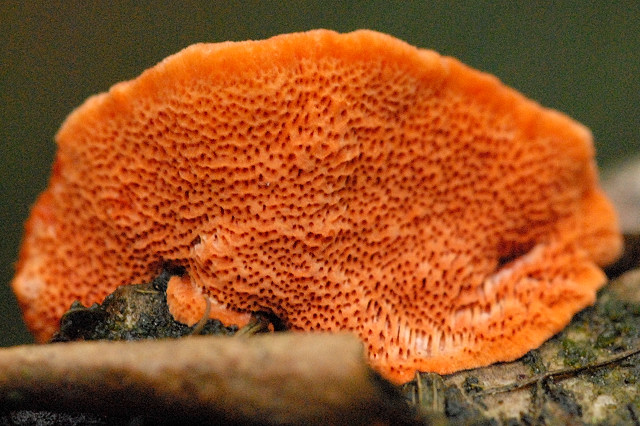
Pycnoporus cinnabarinus
Cinnabar polypore
A white-rot fungus (syn. Trametes cinnabarina) that degrades lignin efficiently although it lacks lignin peroxidase: it produces a high-redox-potential laccase and its own mediator, 3-hydroxyanthranilate, which lets laccase oxidise non-phenolic structures. It is the system on which the laccase-mediator concept was built.
How it works
- Mechanisms
- mycodegradation
- Enzymes
- laccase
Contaminants
| Contaminant | Evidence | What was shown |
|---|---|---|
| Synthetic dyes | laboratory | Not a removal figure: a docking study on a homology model of the laccase indicates that the industrial dyes Acid Blue 74, Reactive Black 5 and Reactive Blue 19 often do not fit the active site, whereas mediators do; dye oxidation by this laccase therefore runs through mediators. The laccase has been made expressible and evolvable in yeast (total activity raised 8,000-fold). |
Limits
For this species we verified only enzyme and mechanism studies, not measurements of pollutant removal from soil or water: it should be regarded as a laccase source, not an organism with demonstrated use in remediation. Synthetic mediators add cost and toxicity of their own.
Sources
- Eggert et al. (1996) A fungal metabolite mediates degradation of non-phenolic lignin structures and synthetic lignin by laccase. FEBS Lett 391:144-148, 1996
- Camarero et al. (2012) Appl Environ Microbiol 78:1370-1384, 2012
- Prasad et al. (2012) J Mol Model 18:2013-2019, 2012
Draft compiled from public sources, not yet reviewed.
Other species for the same contaminants
Species that the literature reports acting on at least one of this one's contaminants, the closest first.