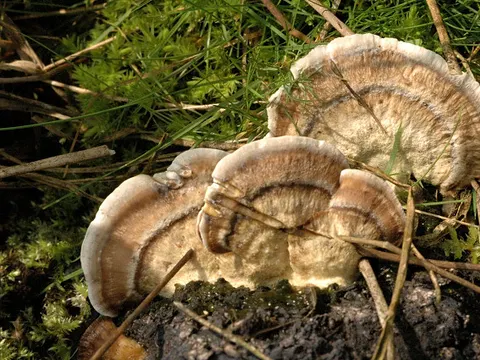
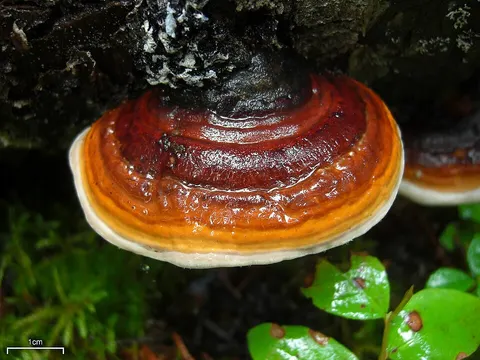
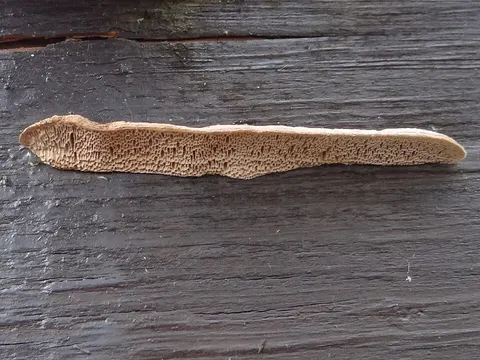
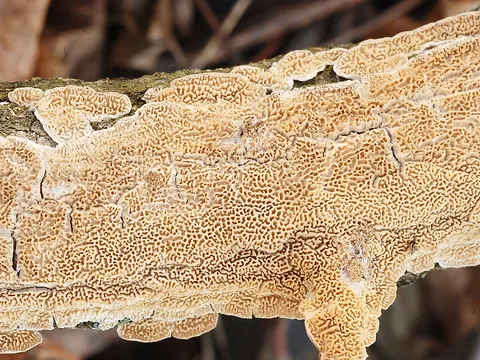
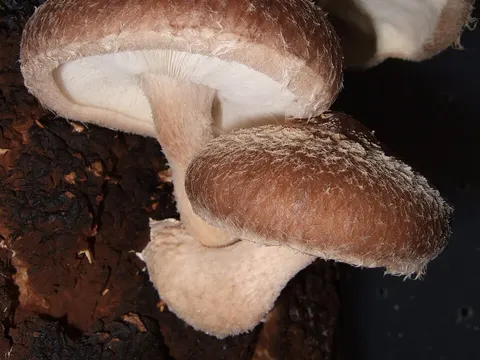
Fungus, white rot
Phanerochaete chrysosporium
The model organism of lignin degradation: lignin peroxidase was isolated here in 1983, and in 1985 the same system was shown to mineralise DDT, PCBs, dioxin, lindane and benzo[a]pyrene. Mycoremediation starts from this work. It has been field-tested on pentachlorophenol soil.
How it works
- Mechanisms
- mycodegradation
- Enzymes
- lignin peroxidase, manganese peroxidase
Contaminants
| Contaminant | Evidence | What was shown |
|---|---|---|
| Phenols and chlorophenols | field | Field study on soil contaminated with a commercial wood preservative (250-400 µg/g pentachlorophenol), inoculated with P. chrysosporium or P. sordida and amended with peat: PCP fell by 88-91% in 6.5 weeks, at suboptimal temperatures and without inorganic nutrients. Only 8-13% of the decrease was methylation to pentachloroanisole; most ended up as non-extractable soil-bound products. |
| DDT and breakdown products | laboratory | In culture the fungus oxidised labelled DDT to CO2; model studies with DDT indicate that the ability depends on the extracellular lignin-degrading system. |
| Polychlorinated biphenyls | laboratory | Mineralisation to CO2 of 3,4,3',4'-tetrachlorobiphenyl and 2,4,5,2',4',5'-hexachlorobiphenyl in culture. |
| Dioxins and furans | laboratory | Mineralisation to CO2 of 2,3,7,8-tetrachlorodibenzo-p-dioxin in culture. |
| Hexachlorocyclohexane (lindane) | laboratory | Mineralisation of lindane to CO2 in culture. |
| Explosives (TNT, RDX) | laboratory | TNT: at 1.3 mg/L, 35.4 ± 3.6% of 14C-TNT was mineralised to CO2 in 18 days. At contaminated-site concentrations (10,000 mg/kg in soil with corncobs, 100 mg/L in water) about 85% of the TNT was degraded in 90 days, with 18.4% and 19.6% converted to CO2. |
Limits
In the field trial PCP was not mineralised but largely bound to soil: the authors themselves state that the nature, stability and toxicity of these residues must be clarified before the method can be considered viable. The 1985 data are mineralisations in pure culture at low concentrations. This species' MnP oxidises industrial azo and phthalocyanine dyes little or not at all (Heinfling et al. 1998), and anthracene stops at anthraquinone (Field et al. 1992). In soil an added organic substrate (peat, corncobs) is needed.
Where it has been tried
US wood-preservative site, PCP-contaminated soil (Lamar and Dietrich field study)
MycoremediationField scale
Phanerochaete chrysosporium, Phanerochaete sordida
Lamar and Dietrich inoculated the soil in the field with two white-rot fungi, adding peat as a carbon source, at temperatures below the fungi's optimum and without mineral nutrients.
Outcome Extractable PCP fell by 88–91% in 6.5 weeks. But 8–13% of the decrease was methylation to pentachloroanisole and most of the PCP turned out to be converted into non-extractable soil-bound products, not mineralised. The authors themselves write that the nature, stability and toxicity of those products must be clarified before the method can be considered viable.
Sources
- Tien & Kirk (1983) Lignin-degrading enzyme from the hymenomycete Phanerochaete chrysosporium Burds. Science 221:661-663, 1983
- Bumpus et al. (1985) Science 228:1434-1436, 1985
- Lamar & Dietrich (1990) Appl Environ Microbiol 56:3093-3100, 1990
- Fernando, Bumpus & Aust (1990) Appl Environ Microbiol 56:1666-1671, 1990
- Heinfling et al. (1998) Appl Environ Microbiol 64:2788-2793, 1998
- Field et al. (1992) Appl Environ Microbiol 58:2219-2226, 1992
Draft compiled from public sources, not yet reviewed.
Other species for the same contaminants
Species that the literature reports acting on at least one of this one's contaminants, the closest first.