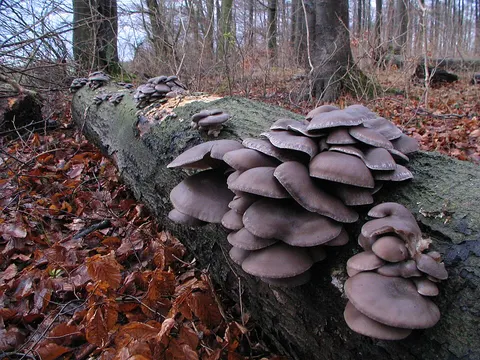
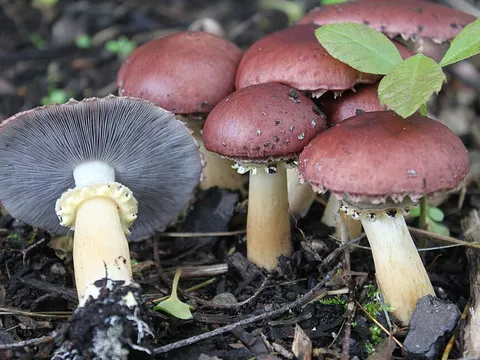
Fungus, white rot
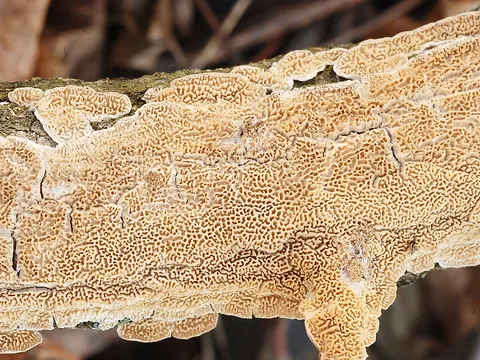
Phlebia brevispora
A white-rot fungus of the genus Phlebia, in which a Japanese group, following phylogeny, found several dioxin degraders. P. brevispora is the first white-rot fungus for which transformation of a recalcitrant tetrachlorodioxin and of coplanar PCBs was demonstrated by identifying the metabolites. A related species, P. radiata, mineralises TNT with its manganese peroxidase.
How it works
- Mechanisms
- mycodegradation
- Enzymes
- manganese peroxidase
Contaminants
| Contaminant | Evidence | What was shown |
|---|---|---|
| Dioxins and furans | laboratory | In culture, 14 days: about 80% of 2,7-dichlorodibenzo-p-dioxin degraded. 1,3,6,8-Tetrachlorodibenzo-p-dioxin, untouched by other Phlebia strains, is transformed into monohydroxy-, monomethoxy- and dimethoxy-tetraCDD, dimethoxy-triCDD and 3,5-dichlorocatechol. |
| Polychlorinated biphenyls | laboratory | Mixture of 11 coplanar PCBs (7 mono-ortho and 4 non-ortho) in culture: 5 congeners degraded, including 3,3',4,4'-tetrachlorobiphenyl and 3,3',4,4',5-pentachlorobiphenyl; meta-methoxylated metabolites identified and, for mono-ortho congeners, para-dechlorinated and methoxylated ones. |
| Explosives (TNT, RDX) | laboratory | Data for Phlebia radiata, not P. brevispora: a cell-free MnP preparation (36 nkat/mL) with 10 mM reduced glutathione transformed 10 mg/L TNT in three days; within 5 days 22% of 14C-TNT and 76% of 14C-2-amino-4,6-dinitrotoluene were mineralised. At 50 mM glutathione degradation is strongly inhibited. |
Limits
All data come from pure liquid culture or isolated enzyme. Only 5 of the 11 coplanar PCBs tested are degraded, and the products are methoxylated and hydroxylated derivatives that are still chlorinated: this is transformation, not complete dechlorination. No soil or field trial was found.
Sources
- Kamei, Suhara & Kondo (2005) Appl Microbiol Biotechnol 69:358-366, 2005
- Kamei et al. (2006) Appl Microbiol Biotechnol 73:932-940, 2006
- Van Aken et al. (1999) Biodegradation 10:83-91, 1999
Draft compiled from public sources, not yet reviewed.
Other species for the same contaminants
Species that the literature reports acting on at least one of this one's contaminants, the closest first.