Fungus, litter decomposer
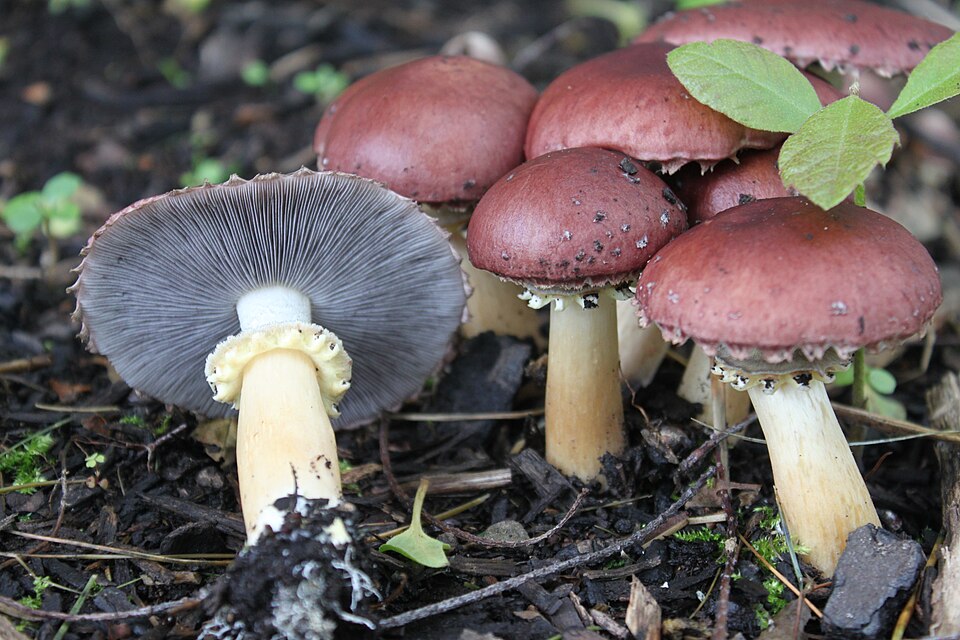
Stropharia rugosoannulata
Wine cap, king stropharia
A litter-decomposing mushroom, edible and easy to grow on straw and wood chips. Unlike many white-rot fungi it is a natural soil dweller, and in non-sterile soil it increases the degradation of heavy PAHs. It is also the species used in stormwater mycofiltration trials.
How it works
- Mechanisms
- mycodegradationmycofiltration
- Enzymes
- laccase, manganese peroxidase
Contaminants
| Contaminant | Evidence | What was shown |
|---|---|---|
| Polycyclic aromatic hydrocarbons | laboratory | Artificially contaminated non-sterile soil (250 mg/kg total PAH), 30 days, 8 litter-decomposing species compared: with fungi up to 70% of benzo[a]anthracene, 86% of benzo[a]pyrene and 84% of dibenzo[a,h]anthracene were removed, against 29%, 26% and 43% by the indigenous microflora alone. S. rugosoannulata and S. coronilla were the most effective. |
| Explosives (TNT, RDX) | laboratory | Cell-free system: S. rugosoannulata manganese peroxidase rapidly converts aminonitrotoluenes, the main intermediates of TNT reduction (2-amino-4,6-dinitrotoluene, 4-amino-2,6-dinitrotoluene, 2,6-diamino-4-nitrotoluene), with partial direct mineralisation to CO2, enhanced by thiols such as reduced glutathione or cysteine.
|
Limits
The PAH data come from freshly contaminated soil, where compounds are more available than at an old site. Light PAHs are degraded by soil microbes anyway: the fungus adds something only for heavy compounds. In mycofiltration of synthetic stormwater (18.6 L columns, 600-900 cfu/100 mL E. coli) E. coli removal relative to control filters was about 20%: a real but small effect (Taylor et al. 2015). E. coli is not in the contaminant vocabulary and is not listed as a target.
Where it has been tried
Finland, old sawmill area (chlorophenols and dioxins)
MycoremediationLaboratory, with soil from the site
Stropharia rugosoannulata
Valentín, Steffen, Hatakka, Tuomela and colleagues screened white-rot and litter-decomposing fungi able to withstand the soil's own microbes, and incubated nine of them for 15 weeks in non-sterile soil or wood.
Outcome In soil the native microbes alone degraded pentachlorophenol and tetrachlorophenol as much as inoculated soil did, only more slowly. Stropharia rugosoannulata degraded 73% of PCP and 43% of 2,3,4,6-TeCP, but only 13% of dioxins and furans (as toxic equivalents). In wood, where there were no effective native degraders, white-rot fungi did better.
Sources
- Steffen et al. (2007) Biodegradation 18:359-369, 2007
- Scheibner & Hofrichter (1998) J Basic Microbiol 38:51-59 (PubMed record), pubmed.ncbi.nlm.nih.gov, 1998
- Taylor et al. (2015) Removal of Escherichia coli from synthetic stormwater using mycofiltration. Ecol Eng 78:79-86, 2015
Draft compiled from public sources, not yet reviewed.
Other species for the same contaminants
Species that the literature reports acting on at least one of this one's contaminants, the closest first.