Plant, herb
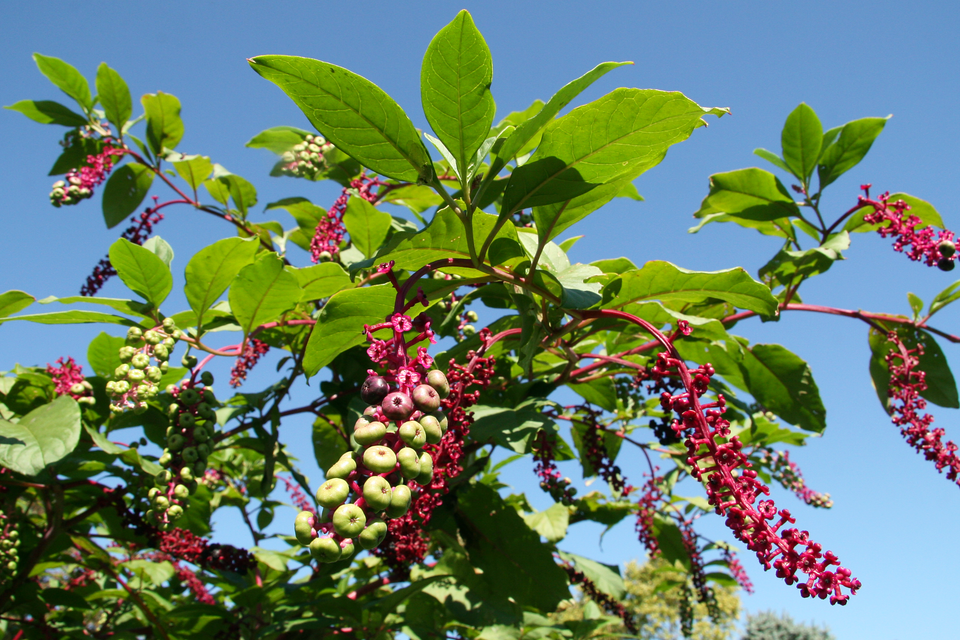
Phytolacca americana
American pokeweed
A large perennial herb that hyperaccumulates manganese in its leaves and accumulates cadmium. It combines accumulation with high biomass, which is rare; accumulation shows, however, only where soil is rich in available manganese.
How it works
- Mechanisms
- hyperaccumulationphytoextraction
- Native range
- North America, including the south-eastern United States
Contaminants
| Contaminant | Evidence | What was shown |
|---|---|---|
| Cadmium | field | Plants sampled at three contaminated sites in China: on average 42 mg/kg Cd in leaves, maximum 402 mg/kg; in hydroponics up to 637 mg/kg in aerial tissues at 100 µM Cd. Accumulation is a constitutive trait and is linked to transpiration (Liu et al. 2010). |
| Manganese | laboratory | Wild plants in the south-eastern United States: about 2,000 µg/g Mn dry weight, against 50–450 µg/g in other species at the same site. In nutrient solution up to 8 mM Mn, leaves exceeded 32,000 µg/g (3.2%) within three weeks (Pollard et al. 2009). |
Limits
In Europe it is an alien species: growing it for remediation carries a risk of spread that must be assessed case by case. At high Mn concentrations the plant excludes part of it by precipitating it as phosphate on the roots (Dou and Qi 2023). The sources consulted contain no field trials with a mass balance of metal removed.
Sources
- Pollard et al., Northeast. Nat. 16(sp5):155, 2009
- Liu et al., Chemosphere 78:1136, 2010
- Dou and Qi, Rhizospheric precipitation of manganese by phosphate: a novel strategy to enhance Mn tolerance in the hyperaccumulator Phytolacca americana, Toxics 11:977, 2023
Draft compiled from public sources, not yet reviewed.
Other species for the same contaminants
Species that the literature reports acting on at least one of this one's contaminants, the closest first.