Plant, tree
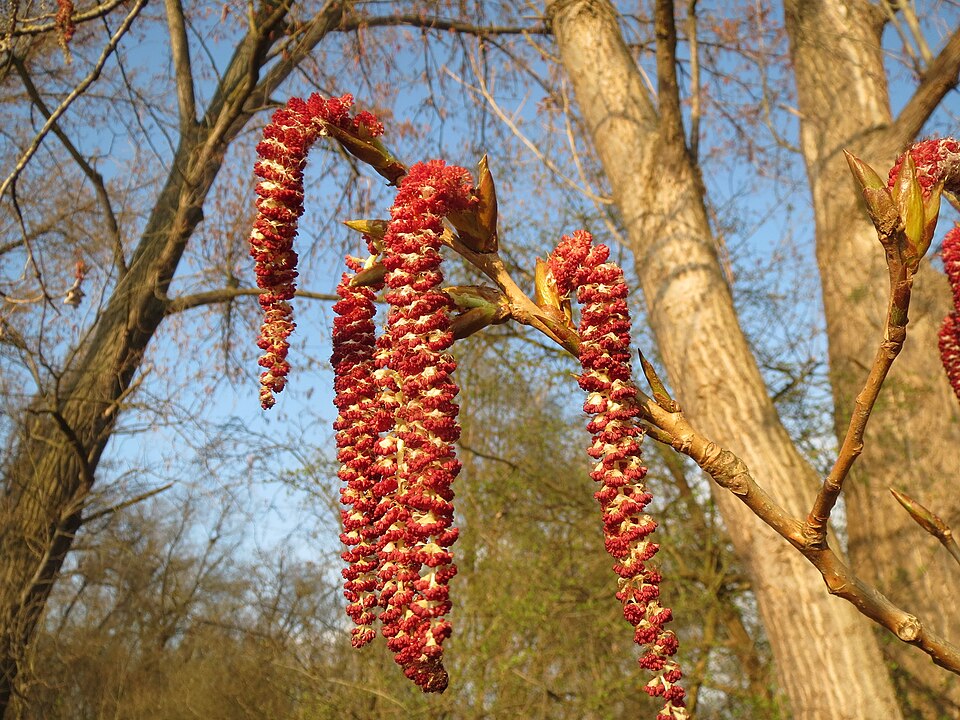
Populus × canadensis
Canadian poplar (P. deltoides × P. nigra)
The hybrid of European black poplar and American cottonwood, the most widely grown in Italian poplar farming (clone I-214). Clone DN34 was used in the United States to establish which organic compounds a tree takes up from water, and coppiced clones have been tested for metals.
How it works
- Mechanisms
- phytodegradationphytovolatilisationhydraulic controlphytoextraction
- Native range
- Cultivated hybrid
Contaminants
| Contaminant | Evidence | What was shown |
|---|---|---|
| Zinc | field | Two-year field trial under hot-arid Mediterranean climate, on moderately contaminated soil: poplar accumulated 3,200 g Zn/ha/year and 182 g Cu/ha/year and lowered the extractable fraction of Cd (37%), Ni (49%), Pb (46%) and Zn (63%); total soil content did not change (Guidi Nissim et al. 2018; the abstract does not name the clone). In a coppice of 17 clones on a former waste site in Belgium, the best clones removed 2.0–2.4 kg Zn/ha and 47–57 g Cd/ha over two years (Laureysens et al. 2005).
|
| Chlorinated solvents (TCE, PCE, chloroform) | laboratory | Twelve organic compounds common at hazardous waste sites, labelled with carbon-14 and supplied hydroponically to hybrid poplars: uptake and partitioning to tissues depend mainly on the octanol-water coefficient (log Kow); for volatile organic compounds, translocation followed by transpiration from leaves to the air is a significant pathway (Burken and Schnoor 1998). |
Limits
For metals, removal is a few kilograms of zinc and tens of grams of cadmium per hectare: soil is not cleaned quickly. Clones I-214 and Eridano, grown on soil amended with tannery sludge, accumulated only small amounts of metals (Tognetti et al. 2004). Burken and Schnoor's data on organics are hydroponic. The field trials cited involve different clones and hybrids: the result depends on the clone.
Where it has been tried
Scarlino, ceneri di arsenopirite (ex Nuova Solmine)
PhytoremediationField scale
Pteris vittata, Populus deltoides 'Dvina', Populus × canadensis 'Orion'
Ciurli, Lenzi, Alpi and Pardossi (University of Pisa) planted the fern Pteris vittata and two poplar clones on the cinders, in pots and on site, following survival, tissue arsenic and stress markers for 24 months. The abstract of that paper does not name the site; Scarlino is given in the same group's later study on the same material. In a greenhouse, Lampis and colleagues then grew the fern for four months on cinders and compost, with and without arsenic-resistant bacteria isolated from the site.
Outcome In the field the authors judge the fern-poplar co-planting suitable, but the abstract gives no amount of arsenic removed and notes that irrigation, tillage and amendments are needed for the plants to establish. In the greenhouse the bacteria raised fern biomass by up to 45% and arsenic removal efficiency from 13% to 35% in four months.
- Ciurli et al., Arsenic uptake and translocation by plants in pot and field experiments, International Journal of Phytoremediation, 2014
- Lampis et al., Promotion of arsenic phytoextraction efficiency in the fern Pteris vittata by the inoculation of As-resistant bacteria: a soil bioremediation perspective, Frontiers in Plant Science, pmc.ncbi.nlm.nih.gov, 2015
Sources
- Burken and Schnoor, Environ. Sci. Technol. 32:3379, 1998
- Guidi Nissim et al., Environ. Sci. Pollut. Res. 25:9114, 2018
- Laureysens et al., Environ. Pollut. 133:541, 2005
- Tognetti et al., Gas exchange and foliage characteristics of two poplar clones grown in soil amended with industrial waste, Tree Physiol. 24:75, 2004
Draft compiled from public sources, not yet reviewed.
Other species for the same contaminants
Species that the literature reports acting on at least one of this one's contaminants, the closest first.