Plant, tree
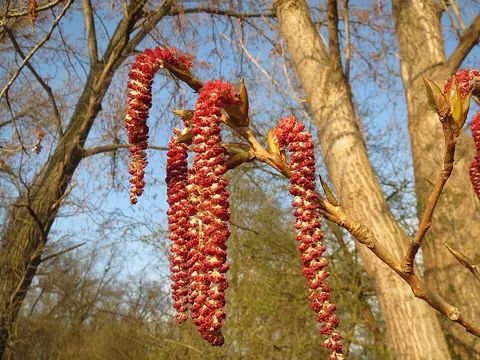
Populus × generosa
Hybrid poplar (P. trichocarpa × P. deltoides)
Very fast-growing hybrid poplars with high transpiration. They are the reference plants for chlorinated solvents in groundwater: they take up trichloroethylene with water and degrade it. The Italian clone Monviso, derived from this hybrid, was used at Taranto on soils with PCBs and metals.
How it works
- Mechanisms
- phytodegradationhydraulic controlphytovolatilisationrhizodegradation
- Native range
- Cultivated hybrid
Contaminants
| Contaminant | Evidence | What was shown |
|---|---|---|
| Chlorinated solvents (TCE, PCE, chloroform) | field | Three-year controlled field study in lined cells fed with contaminated water: during the growing seasons the trees removed over 99% of the added TCE; less than 9% was transpired to the air in the second and third years, and soil chloride rose by about the amount of TCE lost (Newman et al. 1999). Metabolites in tissues are trichloroethanol, trichloroacetic acid and dichloroacetic acid (Newman et al. 1997). At a Superfund site in California, poplars inoculated with a TCE-degrading endophytic bacterium: from 300 µg/L upstream to under 5 µg/L (Doty et al. 2017).
|
| Polychlorinated biphenyls | field | An area near Taranto historically contaminated by PCBs and metals, planted with clone Monviso: at 420 days a significant decrease in PCB congeners and a reduction in all metals where poplars were present, none in unplanted soil; microbial activity raised up to 1 m from the trunk and 40 cm deep (Ancona et al. 2017). |
Limits
The TCE result comes from controlled cells; in a real aquifer roots must reach the contaminated water, usually within a few metres, and transpiration stops in winter. Part of the volatile compounds leaves through the foliage to the air. The Taranto study covers just over a year and a 40 cm layer. Single-clone plantations are exposed to disease.
Where it has been tried
Taranto
PhytoremediationField scale, 2013–2017
Populus generosa × Populus nigra 'Monviso'
CNR-IRSA (Ancona, Barra Caracciolo and colleagues) planted about 650 cuttings of the Monviso poplar clone on 785 m² in April 2013, after a compost dressing. Soil and its microbial community were analysed at planting, after 420 days and after 55 months, at several distances from the trunk and at two depths.
Outcome After 420 days PCB congeners and metals had fallen in the soil under the poplars and not in unplanted soil. At 55 months PCBs, 240 ng/g on average at the start, were below the legal limit of 60 ng/g in the planted plots; nearly all metals were below the limits, cobalt excepted. The unplanted control soil held about 1,400 ng/g of PCBs, more than the starting average of the planted plots, so the comparison with the control should be read with care.
- Ancona et al., Plant-assisted bioremediation of a historically PCB and heavy metal-contaminated area in Southern Italy, New Biotechnology, 2017
- Barra Caracciolo et al., Characterization of the belowground microbial community in a poplar-phytoremediation strategy of a multi-contaminated soil, Frontiers in Microbiology, pmc.ncbi.nlm.nih.gov, 2020
Sources
- Newman et al., Environ. Sci. Technol. 33:2257, osti.gov, 1999
- Newman et al., Environ. Sci. Technol. 31:1062, 1997
- Doty et al., Environ. Sci. Technol. 51:10050, 2017
- Ancona et al., New Biotechnol. 38:65, 2017
Draft compiled from public sources, not yet reviewed.
Other species for the same contaminants
Species that the literature reports acting on at least one of this one's contaminants, the closest first.